A Theologian Evaluates Intelligent Design: Part 2 of 3
Having pointed out five things I like about Intelligent Design, I turn now to five things I don’t like.
Some of my objections address issues of biology and the theory of design itself. Others address the ID movement’s political agenda. Both sets of issues are important to a person considering whether he or she wants to be identified with ID.
One criticism is that Intelligent Design theory has not garnered support in the laboratory or field. I find this a very strong criticism of ID. It carries significant weight, given that empirical research is at the heart of the scientific endeavor.
I admit, however, that I accept reports from scientific experts when it comes to this criticism. I’m not an expert on biology; I’m a theologian and philosopher. I have found, however, the vast majority of biologists oppose ID. They do so largely because the biological data does not support ID’s key idea – irreducible complexity (I’ll address the meaning of irreducible complexity later).
For an interesting survey on the difference between the public’s suspicion of evolution and the scientific community’s affirmation of the theory, see this Pew Research Center study.
My second criticism is that ID promoters sometimes seem interested in changing culture through changing public school science curricula. In this sense, ID is more about culture wars. I admit that I’m nervous when I hear of ID advocates inserting creationist or quasi-creationist statements into the public school science classroom. (See the Dover, PA trial for an example of this.)
I like it when public schools teach the general ideas and histories of religion. My two high school daughters learn about world religions in their public high school, and their experience has been very positive. We talk as a family about what they learn. So it’s not that I’m opposed, in principle, to talking about religion in the public square.
Although I tolerate a variety of religions, I’m a Christian theologian. I am so, in part, because I think Christianity is superior. I make no excuses for this.
I get nervous, however, thinking that a nonChristian public school science teacher might advocate as superior his or her religious perspective on science. If I don’t want a public school system in which, say, Buddhist ideas about the origins of the universe dominate the science discussions, why should I think it fair for my Christian ideas about origins to dominate?
Others criticize ID on philosophical grounds. They say ID is really about metaphysics and not science. I’m less sympathetic with this third criticism, although I share one of its forms.
I think science is always chockfull of metaphysical commitments. It doesn’t bother me that metaphysical issues intersect with scientific ones.
Insofar as critics mean that science alone cannot answer the big questions of life, however, I agree with those who criticize ID. I think the important issues that ID raises fit better in a philosophy course or a course discussing science and religion. In a debate on the Big Questions, we ought to allow ID to fight for a place at the table.
Fourth, I criticize ID leadership for its failure to acknowledge that ID theory and some of its prominent proponents affirm the general theory of evolution. Biologist Michael Behe, for instance, in a prominent ID advocate who thinks we can explain at least some of life’s story in terms of an old earth and natural selection.
In their desire to gath er supporters under a big tent, ID leadership fails to admit openly and frequently that ID jibes with key components in evolutionary theory. As a result, the vast majority of Christians with whom I speak think ID opposes evolution in all its forms. That’s just not true. ID leadership ought to admit so openly and often.
Perhaps my fifth criticism is the most interesting from a scientific view (although readers should find my first criticism also important on scientific grounds). This criticism comes from the ID claim that the irreducible complexity of some organisms requires a designer.
The irreducible complexity argument is that some organisms are so sophisticated they could not have come about through evolutionary processes. Natural selection, random mutation, self-organization, and other natural evolutionary mechanisms are inadequate, say ID supporters, for forming highly sophisticated organisms. Complex organisms require “outside” help from a designer.
For a decade or more, ID advocates have used the illustration of a mousetrap to make this point. Just as mousetrap would not work unless its necessary parts were all fully functioning, ID supporters claim that many complex organisms also require all of their parts to be fully functioning. Without all parts in place, these organisms could not be viable. A mousetrap without one of its parts is useless.
ID biologist, Michael Behe, has made this mousetrap argument famous. He says it is highly unlikely that the parts of some complex organisms would randomly assemble over a long period of evolutionary history without a designer’s help. Natural selection alone is not enough.
Biologist Ken Miller offers an argument against irreducible complexity. Miller says that the parts necessary for various complex creatures may have originally evolved for other purposes. After evolving for purposes largely unrelated to their present purpose, evolutionary forces brought these individual parts together in a highly specialized way.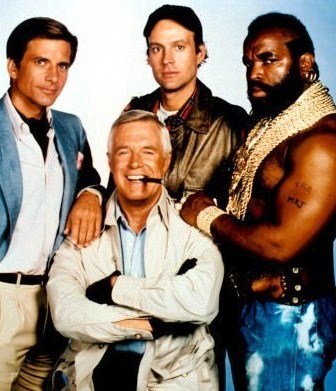
I think the old TV show, The A-Team, illustrates Miller’s point. The A-Team was constructed of separate individuals, each with specialized tasks. Before joining the team, each member was involved in some previous line of work that honed his special skills. That previous work often had nothing directly to do with the work done by the A-team. When each member came to the team, however, his previously developed skills helped make the A-team a crime-stopping unit. Together, the whole was greater than the sum of its parts – parts that were originally meant for other purposes. Pity the fool who thinks otherwise.
Given my “no to that” but “yes to this” approach to ID, readers will not likely be surprised that I cannot identify myself with the ID movement or its key ideas. While I like some things, the things I don’t like are highly significant.
As I said in my previous essay, I’m all for the idea of design itself. I think designing occurs through God’s activity as Creator and creaturely activity in response. I prefer to think of “design” as one subset of the overarching category “create.”
I affirm the benefits of ID while overcoming its liabilities by accepting one of the many versions of theistic evolution. At its core, theistic evolution simply says that the idea that God is Creator is compatible with the idea that God creates through evolution. In one sense, the theory is quite simple.
Admittedly, theistic evolution asks us to think deeply about what we mean by “evolution” and the Christian belief that “God is Creator.” But careful thinking is required of all good science and good theology.
Theistic evolution sees the best and dominant views of science as fundamentally compatible with the best and dominant views of Christian theology. It’s a win-win situation.
I must admit that some versions of theistic evolution are more compelling than others. But generally speaking, this way of thinking about the development of life is better than theories of evolution denying God and Intelligent Design.
I do have one more criticism of ID yet to share. It’s specifically theological. But given all that I want to say about that criticism, I’ll wait to share it in part three of this series.

Newsletter
For a 200-page book of Thomas Jay Oord's best-selling writings and to receive his newsletter, add your email address...
Comments
So, what do you see as an alternative to ID? Since a law of Physics is that things tend to go from order to disorder and from complexity to simplicity, neither chance nor random selection can logically posit “evolution.”
The A team analogy seems considerably different than a few cells from separate organisms in various places randomly uniting to function in an evolved organism.
Perhaps the similarity found in species that that is heralded as evolution is actually only evidence that a common Creator intelligently made them. In so doing He intelligently designed a higher order and with increasing complexity.
The science of Genetics insists that all mutations are a dead. The science of mathematics holds that with the increase of time, probability of decreases relative to movement from disorder to order and simplicity to complexity.
Thus, if the alternative is a Creator, and if such a Creator is infinite, logic might suggest that intelligent design is reasonable. And since time itself is a creature, It may also serve it’s Master differently that some scientist suppose.
Hi Dr. Oord,
I’ve long been open to the idea of theistic evolution. In my mind, the “how” of God’s Creation is less important than the “who, “what,” and “why.”
But I’m left with one agonizing question as I try to balance science and faith: how can we explain the nature of sin (explained through Genesis as the “fall”) through theistic evolution? If sin is just a natural state in the world, then why do we need salvation from it?
I enjoyed reading your blog post, and I look forward to Part 3.
Dr. Oord,
I like many of these criticism, especially the desire to get away from the irreducible complexity argument. However, I think the first criticism assumes that all (or at least the vast majority) of biologists are unbiased in their research and data analysis. I think the presentation of science is much more biased then we hope.
I do not think that the fact that a majority of biologists oppose ID is grounds to reject it. It could simply mean that of the select few scientists who were polled, a majority opposed ID. The scientific community is extremely selective in who they allow to be in the public eye, and even a survey like the one you posted may be quite biased.
I think this is a balanced approach, Tom (speaking particularly of pts. 1 and 2 of your ID critique). I appreciate the thoughtfulness here, and I LOVE the A-Team reference, by the way!
Charles
Thanks for these helpful comments! I want to address two topics briefly in response:
1. Josh asked about sin and theistic evolution. As I see it, theistic evolution need not oppose the usual arguments for the fall and/or original sin. That is, so long as one thinks that humans first emerged “pure.”
However, I think it more likely that theistic evolution should draw us toward Eastern Orthodox ideas of creation and fall. In that tradition, theologians are less likely to emphasize an original state of sinless perfection and more likely to emphasize growth toward maturity.
With regard to Nathan’s claim that scientists are biased, I agree. No one, including Nathan and me, are unbiased. But I do think there are mechanisms in science that push scientists toward greater objectivity. They aren’t perfect. And the same data can be used to support differing theories. Overall, however, I oppose the view that Intelligent Design has not been given a fair hearing in the scientific community because the majority of scientists are unjustifiably biased against it. In fact, I know a great number of scientists who are Christians who would like ID or something like it to be substantiated. But ID has not been well substantiated.
Hoping this helps…
Tom
It does seem that it is safer to offer the nihilistic and evolutional approach in public schools, if only because ID is so easy to politicize. Science inherently brings up political and religious questions, since it offers answers to real questions, and sometimes scientific theory is too controversial to issue to people without the philosophical training to treat it as theory.
Furthermore, science, as Nathan stated, is not necessarily scientific. Global Warming, Marxism, evolutionary psychology, and others (and often ID) are all social phenomena, which is fueled by people who assume the theory and defend consensus apart from an empirical experiment or a metaphysical attempt at criticism. “Science” is the religion of our time.
I have the same criticism of ID where many believers believe that intelligent design rejects all evolutionary theories. I don’t think this was the greatest idea in the world, but my friend Brian in college taught a Sunday School class where he taught about Theistic evolution. After this class, some of the parents in the church were calling for his head because in church he was teaching about evolution. It is sad that we often have to keep ideas of Theistic evolution to ourselves for fear that we might lose our job as a minister or Sunday School teacher because of it.
I have a tendency to lean toward the idea of Theistic evolution. Having been taught both Evolution and Creation theories I have always felt that there could be good stuff from both but never felt comfortable to really discuss this idea before. It has been very nice to be able to think freely and not feel like I could get into trouble by what was going on inside of my mind.
Thomas Oord made this comment, “I like it when public schools teach the general ideas and histories of religion.” I would agree that our children need to know about history of religion. I would even agree that a broad scope of world history and religion is beneficial. My concern is over who is teaching and where history and religion is being taught. I have a son who graduated high school two years ago, and during his high school education in California a balanced educational stand point was not evident. In fact, Christianity as a religion and Christian influences in history were not mentioned at all. I brought my questions and concerns to the school administration and I was shunned. I am not opposed to having Intelligent Design taught, just like I am not opposed to having the various religions and history taught. However, I am opposed to having them taught while ignoring completely Christianity and the Christian influence in history. In closing, I understand that I might seem closed minded and argumentative to those of the world. However, the Christian community is asked over and over to be tolerant, while the various world religions are being taught with no restraint.
I guess I never thoroughly understood Intelligent Design. I always thought that ID was entirely against the evolutionary theory. I have started leaning toward theistic evolution, in that I find that it makes the most sense to me logically. The problem I have with the ID argument,that some things are too complex to have been designed, is that it selects certain aspects of nature and not others. If God set up the evolutionary mechanism and creates through it, why would that not be superior enough to bring about the complexity we see in our world?
In reference to the public school issue, I believe that only the evolutionary theory should be taught in biology classes. It is the best scientific theory that we have right now. That does not mean it is 100% correct, but that could be said about most of the scientific principles we teach in our schools. I agree that philosophical and theological issues should be addressed in other courses, such as a world religions course.
The Intelligent Design is interesting to think about. I do not know the theory entirely though. I agree with Kara that I learn more to the theistic evolution side of this on-going debate between everyone and every theory about our existence. The first criticism that you stated about the Intelligent Design not being supported in the lab, well I see this to be true because even the creation theory cannot, technically, be supported in the lab. These are all theories that will not be proven or dis-proven, more like supported more or not supported at all (or less than others). But in all, they are theories.
Addressing the implications for ID in public schools is an incredibly important topic for with ID comes another theory with religious implications, astrology. For Intelligent design, there is a designer which manipulates the formation of certain aspects of biology with out the use of natural forces. In the same way Astrology offers the placement of stars by a designer.
If intelligent design is offered to be taught alongside evolution, astrology must be offered along with astronomy.
I, like many of my peers I’m sure, basically saw ID as the more scientific name for creationism, since we can’t really talk about it in school. However, especially since today’s presentation and reading this post, I have really been blown away by how ignorant I was to this! I don’t believe at all that it’s possible to actually believe in something that not only has zero empirical evidence, but also lacks any historical backing as well (whether it’s true or not, at least Creationism has a book written about it!) Even more than that I have been interested to know that some people in the ID community don’t believe that their Creator is God is also silly to me as well, because what kind of basis does that provide for converts, especially when evolution is so all encompassing? In the end, ID really seems much sillier to me than Creationism.
I definitely agree with the problems found with the theory of Intelligent Design. I believe they may have pure intentions, but claiming to be science is a stretch. What they do is still science, but they have not biological or experimental support. They have a problem with the natural selection of evolution, but evolutionists can support their theory, ID theorists cannot.
I have learned so much more about ID in this class. I agree with the idea that ID broke off from creationism with the goal of begin excepted it the world of science and get creationists ideas in schools. The problem is that many of the fellows argue that their theory still supports the idea of god as the designer. The problem is though that their theory does not a firm this nor are the significant figures in theory always able to agree on exactly what their theory means.
I think I have been learning a different kind of ID than whoever else everyone is talking too, and maybe whoever taught me ID knew these downfalls and presented only the good stuff. I knew that irreducible complexity was one of ID’s main arguments, but I thought it was more of a dissenting view than something that needed to be empirically proved. Biology needs to answer how these features came to exist through natural processes and how mutations can add genetic material, and after a whole semester of discussing this issue I still have not hear evidence in response to the questions ID brings up. In interviews I have listened to on my own even Dawkins can’t answer these questions. The usual responses are 1) we’ll figure it out in time, or 2) we know it had to have happened, so the answer is there. Part one of this blog post mentioned 5 things that were good about ID.¬ One of them that I think should be mentioned is that they are thinking critically about some of the weaker parts of the evolutionary theory.
ps. I read Ronald’s comment after I wrote this, but I think he is getting at the same idea as I am.
It seems as if the ID movement is one of picking and choosing. I agree that ID, at this point holds little ground, especiallly considering its lack of empirical evidence. I like the idea of major religions being taught in schools because then we are emphasizing culture and their ideologies over pushing an agenda either which way (science, Christian, Buddhist, etc.) but recognize each. It is hard for me to understand Why identifiers with ID would reject someone so strongly supported, evidence wise, as evolution and not seemingly note the plausibility of their ID as being part of evolution…
I appreciated these points against ID. I have never fully heard an argument against irreducible complexity (perhaps due to a creationist background), and the one used is a strong argument. Once again I find myself picking and choosing principles and theories from every side and forming my own view that doesn’t really fit in any “category”. There are things about each that I like and dislike. I suppose this is all just part of becoming “well-rounded”.
Alright, so you struck a nerve with me not a negative but in any case a nerve. I am a former home schooling parent and a current home schooling aunt. I have never thought about the stand you make about a person of another religion trying to explain the truth or my faith and that which I am trying to train child in. I am very much in agreement with you on this one. I watched as some online teachers tried to teach my very strong daughter in other religions and spending a week on each and then she got very mad because there was only one lesson dedicated to teaching the arts of Christianity.