Polkinghorne’s Twin Concerns
A vegetarian butcher. That’s the combination some people think analogous to being both a scientist and theologian.
Yet John Polkinghorne is just that: a physicist and a priest. Combining the two in one person is likely to arouse curiosity and perhaps suspicion.
Polkinghorne believes that together, both science and theology provide a particularly good vision of the world. Like the two scopes of a binocular working in tandem to improve vision, science and religion offer essential perspectives for the great quest for truth.
Polkinghorne earned a Ph.D. in physics from Cambridge University about 50 years ago. He titled his first book about particle physics, The Particle Play. The book “gives an account of where we had found ourselves when the dust had finally settled on that phase of particle physics during which I had been an active participant,” Polkinghorne reports. A second book, Quantum World (1984), has proven the bestselling of the more than thirty-five volumes he has penned.
After almost two decades of research and teaching in physics, Polkinghorne decided to prepare for ordained Christian ministry in the Church of England. “I simply felt that I had done my little bit to particle theory,” he explains, “and the time had come to do something else.” The transition from working physicist to burgeoning priest led Polkinghorne to pen his newly forming ideas about the relationship between his Christian faith and science.
Cambridge invited Polkinghorne back to serve as the Dean and Chaplain at Trinity Hall. After a short period at Trinity Hall, however, Queens’ College at Cambridge elected him as its president. He finished his career as in this capacity and retired in 1996.
Polkinghorne has been a prolific interdisciplinary author. This kind of writing “requires a degree of intellectual boldness and a degree of intellectual charity,” he says. “I strive to be two-eyed, looking at both with the eye of science and with the eye of religion, and such binocular vision enables me to see more than may be possible with either eye on its own.”
This double focus also leads to a double mission. “On the one hand,” says Polkinghorne, he tries in his writing “to encourage scientists to take religion seriously and not dismiss it unreflectively without a hearing.” On the other hand, he tries to “encourage religious people to take science seriously and not to fear the truth that it brings.”
The vision of God, c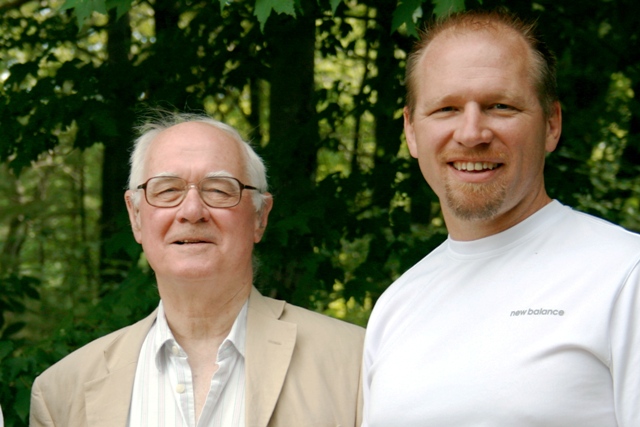 reatures, and the world Polkinghorne offers makes possible a genuine conversation between science and theology. “If I can act in this way in a world of becoming that is open to its future,” argues Polkinghorne, “I see no reason to suppose that God, that world’s Creator, cannot also act providentially in some analogous way within the course of its history.” This suggests that God provides some freedom and agency to creatures. “God interacts with creatures,” he explains, “but does not over-rule the gift of due independence with which they have been given.”
After an illustrious career of teaching, lecturing, and writing, John Polkinghorne has been awarded a variety of honors. In 1993 and 1994, he was invited to give the Gifford lectures at Edinburgh University. He chose to concentrate most of his lectures defending the cogency and fruitfulness of the Christian Nicene Creed. He was awarded the Templeton Prize in 2002. He plans to celebrate his 80th birthday this coming October.
When I think about John Polkinghorne’s research at the science and Christian theology interface, I am reminded of the words of the Apostle Paul. He wrote to Christians in Rome that “what made be known about God is plain to them, because God has shown it to them. Ever since the creation of the world his eternal power and divine nature, invisible though they are, have been understood and seen through the things he has made” (Rm. 1:19-20; NRSV).
I have been so impressed with Polkinghorne’s work that in the summer of 2007, I approached John with an idea. I suggested bringing together som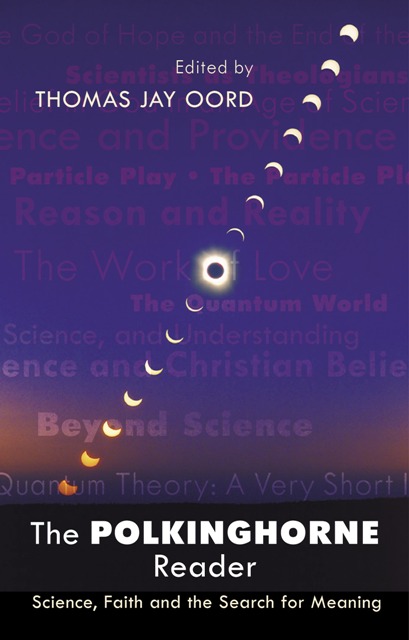 e of his best material in various small books. He agreed that the project needed to be done. I proposed that we work together to construct a Polkinghorne reader. I am grateful to Templeton Press and SPCK who agreed to co-publish the resulting book I edited, The Polkinghorne Reader: Science, Faith and the Search for Meaning. It will appear in print this summer.
While I was confident that a book drawing together some of the best from John’s books would be attractive to those who ponder issues in science and theology, I was equally confident that having John select the various excerpts for the book would be vital. In editing this book, therefore, I relied heavily upon John’s own preferences for what should be included. The result is a book that presents some of what John himself considers the best of his wide-ranging contributions to the field.
I have noticed a few websites already advertising The Polkinghorne Reader. I will post a link to one of them when the book is ready for pre-ordering. I plan to present a copy to John as a gift for his 80th birthday.

Newsletter
For a 200-page book of Thomas Jay Oord's best-selling writings and to receive his newsletter, add your email address...
Comments
I like Polkinghorne too, so, I’ll read it…
I admire scientists who publicly talk about religion. I think it is often hard to do for many scientists in the current hostile environment. Hopefully, books like this one and Anthony Flew’s newest writings will influence Christian who are a part of the scientific community to be more open about their faith. I think this is a great example that many should follow. I am pretty interested in reading it now…
In order to even argue against someone, you must be knowledgeable in it (like science v. religion). That would be one reason to learn in both those areas yet also, I agree that they both have an effect on one another. The way God created this world is obvious that everything works together in order to live and grow. Somewhat like the circle of life. I believe this have a lot to do with science as well.
I hate the mindset that views religion as diametrically opposed to science, so it would be refreshing to hear some interdisciplinary opinions on the subject. Sounds like an interesting man and book.
To be fair, positivism science uses explanation to understand our world. So, does theology and when those terms of explanation conflict, such as why people do bad things, or even the origins of our own behavior; conflict arises. That said Polkinghorne has some very good ideas, even if it might present a danger to divine intervention.
It is amazing to think about how perfect creation is. The shear volume of things that could have or can go wrong are staggering to consider! The importance of perspective in reference to matters like science and religion can’t be highlighted enough.
7-4——10
I did 7 years theology after being a Farmer.
“SCIENCE TEACHES US HOW GOD MADE THE UINIVERSE. THEOLOGY TEACHES US WHY GOD MADE US”
I really don’t think there is a reason why scientists and Christians can’t work together. Just like Polkinghorne said, he can see things now better than people who only take one side or the other. As Christians we shouldn’t be scared of science. I think what scares us is not knowing.
Still not sure which camp I’m in, specifically since science seems to have cornered the market on giving “elegant” descriptions of phenomena. This ends, however, when science appeals to complete randomness and chaos to provide the grounds for biogenesis. Religion must be able to adopt a coherent and elegant explanation for life (both how it is created and lived). Furthermore, I’m not sure science can escape its own contingency – not so much the contingency of its systems (which is still a problem) but the contingency of tested experience; i.e. it can tell us what seems to be (physical norms) without ever exhausting noumental possibilities.
so, current understanding; If religion and science can provide an elegant and coherent understanding of the universe (in intelligible terms) then they are compatible. If either system is capable of being coherent and compatible than one ore more system must be withdrawn and reworked.
I’ve read several of Polkinghorne’s works and a compilation of some of his best and most influential works would be great. I admire his attempt to use both religion and science. I too do not believe they are truly at odds in the ways many assume. I enjoyed his comments in our most recent Love video. It’s always nice to hear from intellectual Christians.
I really like the ideas and concepts Polkinghorne presents. Before taking the course philosophy of Science and being introduced to Polkinghorne and the idea of science and religion working together I had always considered them as separate. My ways of thinking about science and religion now that I have been knowledgeably exposed to the two sides have taken a shift. I like what Polkinghorne says when he talks about his approach of seeing religion and science working together. The idea of being “two-eyed” is something that I myself is going to have to practice and hopefully share.
I think more people like John Polkinghorne is what is needed in the science and religion discussion. I think that science and religion can work together to better understand the world. Science can try to explain the how, what, where and religion can explain the why. To often we quote people who are on polar opposites that oppose one another. We have scientists who disregard religion and we have clergy who disregard science. This is unhealthy and people like John are the ones who will bring this debate and make it a discussion.
I really appreciate and value the idea that science and religion are like the two lenses of binoculars. Growing up I was taught that when science seems to go against what the Bible literally says, it is wrong and heretical. My freshman year of college I learned that the Bible needs to be read in context and that science and religion aren’t necessarily in conflict. The binocular analogy I think is a great way to explain how both religion and science have a common goal for finding truth, just different aspects of truth. Science can’t tell us why, or give us meaning; and religion can’t tell us how everything works. When you view the world through them working together, there is a much fuller and more complete understanding of the universe.
Adding to the binocular vision concept of one eye looking closely upon theology, and the other upon science, it works really well because with binoculars, both eyes share a common area, much like a venn diagram. So in one eye the individual sees religion, and the other science, but once both eyes are opened the two different views fuse together, and ultimately complete each other.
I think that, out of all the scopes we have looked at so far in this Philosophy course, Polkinghornes are the greatest due to his dual lens outlook on both science and faith. I have done a lot of thinking on how science and faith are related to one another and something that has really struck me, that I have actually come to find is something Polkinghorne holds to as well, is that both are seeking truth, though through different mechanisms. One aims to explain through the metaphysical, and the other, the physical, which I find strangely attractive and complimentary of one another. Though we have only hit the surface of this very book, Polkinghorne epitomizes what I believe in just a few short sentences. I love it.
I agree with him that science and religion can work together and they need to. Science can often tell us how something works not why. Why does it work that particular way? Religion gives us the reason and purpose not only for our lives, but everything really every cell has a God ordained purpose even if do not know what it is.
Dr. Polkinhorne is a very talented guy and someone who loves Jesus. I have been reading through his book The Polkinghorne Reader and really came to love it. I would have to also agree with his notion that science and religion work together. I think this is what the Lord wanted for science and religion to come together. Yes there is going to be alot of mis consumptions, but in the end the Lord is in control and we have to be with the one we love.