
Michael Lodahl’s new book, Claiming Abraham: Reading the Bible and the Qur’an Side by Side, is simply an exciting read! His theological interpretation of these sacred texts should help Christians and Muslims identify their theological similarities and differences.
While a significant amount of historical and cultural research informs the book, Michael’s greatest insights – and the thrust of the book itself – are theological. At its basis, Lodahl’s argument is that “the Bible and Qur’an often construe God, humans, and the world as a whole in noticeably different ways—and in ways that make for significant differences both in theology and in practice” (4).
Lodahl masterfully presents differing Jewish, Christian, and Muslim trajectories of interpretation in the chapters of the book. The differences are theologically important. 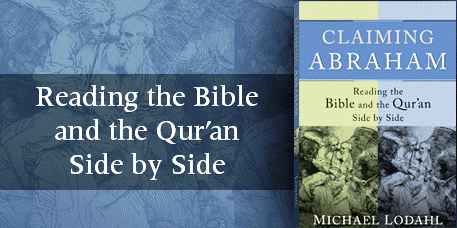
I considered a chapter-by-chapter review of the helpful insights I discovered in Claiming Abraham. But such an approach would make for a lengthy review. So I’ve decide to pick out what I think are major highlights.
The following are highly oversimplified summaries of what I regard as some of the more exciting insights from the book…
Revelation
Muslims are people of a book — the Qur’an. Christians are people of a person – Jesus Christ.
Revelation in Islam is neat and clean; while “revelation in Christianity is inevitably and inescapably a messy and ambiguous phenomenon,” says Lodahl. Interestingly, the Muslim view of Qur’anic inspiration and infallibility corresponds rather well with Christian Fundamentalism, not the historic Christian (especially Wesleyan) view of sacred scripture.
Jesus and Qur’an
Muslim scholars debate whether the Qur’an, as a heavenly book, was created or uncreated. This debate parallels the historic Christian discussion of whether Jesus was created or uncreated. This parallel gives strong clues about what each religion believes is its central revelation.
God as Creator
Muslims view God’s creative activity as unilateral. God says, “Be,” and it is.
The Bible views God’s creative activity as inviting creatures to join in the creation process. For instance, Genesis says God asks humans to name creatures, while the Qur’an reports that Allah has the names eternally predetermined.
Neither the Bible nor the Qur’an explicitly supports creation from absolutely nothing.
Submission vs. Cooperation
Allah’s will shall be done no matter what creatures do. The efficacy of God’s will, by contrast, rests at least in part in creaturely cooperation.
Allah demands submission; God seeks cooperation. To put it simply: Allah exerts power over, while God empowers others.
God and an Open Future
Allah acts from a stance in which all things are eternally settled. God, however, is open “to new possibilities, perhaps even to surprises,” says Lodahl, “in our world of human creativity and open futures” (90).
A small group of Muslims known as Mu’tazilites taught that Allah faced an open future. But this Islamic sub-tradition was silenced. Christian scriptures better support the view that the future is open even for God.
Prevenient Grace
The doctrine of prevenient grace provides a beginning point for a Christian theology of Muhammad’s significance. Christians can affirm God’s influence upon Muhammad without affirming that Muhammad’s ideas are infallible or even better than Christian ideas.
Eschatology and Divine Power
The Qur’an teaches that the world will end in God’s display of apocalyptic and supreme power.A omnipotent God will unilaterally end all things.
The Philippians passage in the Christian Bible, by contrast, suggests that “it is not God’s nature to insist upon ‘being God’,” says Lodahl, “but instead always to be self-giving, self-emptying Spirit-outpouring” (195). Lodahl argues that because there is “no evidence that God is interested in coercing Christians into a life together,” we have no good reason to “expect that at some point God will resort to coercion, a kind of divine violence, in order to usher in a world of righteous love” (198).
Conclusion
To close this brief review, I want to quote the second to last paragraph in the book. It is preceded by Lodahl’s argument that a Christian interpretation of God and God’s activity in creation “should be unafraid and unashamed to acknowledge the role of human beings, or ‘the human element’.” The Christian view differs radically from Islam, because it affirms “God’s profound investment in divine-human collaboration” (206).
Here’s the second to last paragraph in the book:
“A full appreciation of the theological vision of colaboring moves us, I believe, to resist the recurring temptation to demand closure, to formulate easy answers, to seek deliverance from ambiguity of the happy burden of interpretation which is our lot. It appears that we – Jews, Christians, Muslims, and many other from virtually countless religious traditions – shall continue to open, which means to reopen, the texts of Holy Writ and of the world in which we find ourselves. May we become faithful readings in the spirit of humble prayer” (206).
Amen!