
I spoke at The Table church about what has been happening in my life and at Northwest Nazarene University in recent weeks, months, and years. I tried to share my testimony in terms of ten love lessons I have been learning.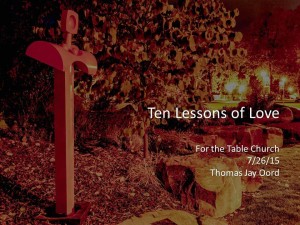
The full talk/sermon was recorded as a video (thanks, Hal Paul), and you can click the powerpoint photo on the right to watch it. Instead of giving the full manuscript, I offer here the ten love lessons with very brief comments related to each.
I believe that telling this story can be a powerful act of love, because it can help bring healing and transformation. And this leads to the first lesson of love:
1. Healing and transformation are hallmarks of love. But healing and transformation are not possible if we ignore conflict and injustice.
As I see it, love involves our talking frankly about conflict and what we believe is unjust. Ignoring conflict and being silent about what appears to be injustice is a form of tearing down not building up.
I speak from my own perspective. All perspectives, including mine, are limited. I do not know the whole truth. But admitting that we do not know the whole truth and seeking to become better informed are themselves acts of love.
[bctt tweet=”Healing and transformation are not possible if we ignore conflict and injustice.”]
This is the second love lesson:
2. Love includes being humble about what we believe we know and a willingness to learn from others.
Despite the many grievances I and other faculty have had against the president’s leadership over the years, I had done my best to interpret his words and actions as charitably as I could. And this brings me to my third lesson in love:
3. Love tries to give a charitable interpretation to someone else’s word or actions… until repeated negative actions from that person makes charitable interpretations unwise, because they undermine the well-being of friends, family, and oneself.
Numerous events prior to these and during this period finally forced me to decide that, for the well-being of my colleagues, my family, and me, I could no longer always give the actions and motives of others a charitable interpretation.
Throughout the previous weeks, months, and years, I have come to understand that keeping all of the matters a secret may not be best. Secrecy couched as “confidentiality” often does not promote my good, my colleagues’ good, the university’s good, nor good for the whole.
[bctt tweet=”Secrecy couched as “confidentiality” often does not promote the common good.”]
This leads me to my fourth love lesson:
4. Transparency and openness, not secrecy, is usually the way of love.
I am not saying that all information should be available to everyone at all times. But too often, those in power want to keep information from others.
For a number of reasons, I came to believe I was being treated unjustly, especially when it came to my being laid off in March of 2015. But because we each as individuals can get a distorted view of what is fair and just, I asked many people inside and outside the campus community if they thought I was being treated unfairly.
[bctt tweet=”Transparency and openness, not secrecy, is usually the way of love.”]
This brings me to the fifth lesson of love:
5. Love seeks the common good, which means assessing what overall well-being requires. Good assessing requires becoming well informed, often by listening well to others and allowing others to shape our perspectives.
I listened, and listened, and listened to many people. I sought counsel from people on campus, especially faculty and staff, because the campus community understood the situation best. But I also talked with many people off campus. Overwhelmingly, these people said that I had been unfairly targeted and treated unjustly.
The faculty no-confidence vote in the president shows that the overwhelming majority of faculty was not happy with the president’s leadership. My situation was just one point of dissatisfaction for the faculty.
The sixth love lesson I have learned in the last four months is a lesson I have known for some time but saw demonstrated more powerfully than I could have imagined:
6. The power of loving communities to work for well-being is far greater than the power of an individual.
The loving responses to my own situation in particular and the goings on at NNU have been powerful. These positive responses have come in many forms, as people have spoken or acted in ways for my good and the common good.
The power of a loving community can be exponentially greater than the power of individuals trying in isolation to work for the common good. I have no doubt that this same kind of work in community will be necessary for transformation and healing needed in the future.
[bctt tweet=”The power of loving communities to work for well-being is far greater than the power of an individual.”]
7. Developing the habits of love – a.k.a. “character formation” or “becoming virtuous” – helps a person deal with turmoil and difficulty. Those habits can help us as we decide how to love in each moment.
I have much to learn and much to develop when it comes to being a loving person. I want to love as Jesus Christ loves. But although I am not where I would like to be, I have matured in some areas and developed various habits of life.
Throughout the difficulties of the last years and especially the last four months, I realized that my past efforts to develop a life of love have established certain habits of mind and habits of heart that have been helpful now. My ability to love well in difficult times comes in part from my efforts to love well in less difficult times. Again, I am not perfect. But I have learned in a deeper way the power of developing in my own life the habits of love.
8. Encouragement, words of affirmation, and displays of support can be powerful expressions of love!
I could talk all evening about the ways that you and so many others have loved my family and me. As I wrote this sermon, I most felt like crying when I reflected on this lesson of love. I am SO, SO, SO grateful for what so many have done for my family and me!
The ninth lesson of love is one I learned as I heard from various people who seemed to believe that questioning the decisions of those in authority was an act of disobeying God. The ninth lesson of love is this:
9. Obeying and trusting authorities can be acts of love. But when those in power act in unloving ways, they are not doing God’s will.
We should have proper respect for authorities. But we should also assess them and their leadership through the lens of love. If leaders act in unloving ways or their decisions do not promote the common good, we need not agree or endorse those decisions.
[bctt tweet=”Obeying authorities can be loving. But when authorities are unloving, they do not reflect God’s will.”]
10. Forgiveness is an act of love when it wishes well to those who have done harm. Forgiveness does not require forgetting or ignoring the harm. But it does not seek revenge.
Let me repeat tonight what I have said on many occasions in the past: I forgive those who have harmed me. I do not seek revenge. I will not be bitter. I will not repay evil with evil, but I will repay evil with good. I forgive.
Let me conclude with a few words about the future:
There is much work to be done to help my colleagues have a better working situation, to help make NNU a better place, to help the Church of the Nazarene think better about what it means to think carefully and creatively about faith. There is much work to be done in the wider Christian community to understand what it means to love in a world that is changing rapidly and asking big and complicated questions.
I plan to contribute to helping my colleagues, the university, my denomination, Christendom, and the wider world outside Christian communities. I am not leaving the Church of the Nazarene, but I am expanding my vision for ministry to include in greater ways those outside the denomination.
When I first spoke publicly after being laid off, I ended my talk by saying, “No matter what happens to me, I plan to live a life of love.”
Those words remain true today. They are my goal for what happens now and my plan for the future. I have learned new lessons of love these past weeks, months, and years. I appreciate your allowing me to share those lessons with you.
[bctt tweet=”No matter what happens to me, I plan to live a life of love.”]