
In my recent writing, I have argued that God’s love is uncontrolling. Consequently, God can’t prevent evil by controlling others.
I’ve also been saying that we should embrace the idea that God is a universal Spirit without a localized body. Embracing this idea is crucial too.
Universal Spirit
The vast majority of Christians (and Jews and Muslims) have said God is a universal spirit. When struggling to comprehend God’s form or constitution, they have asked questions like —
Is God located somewhere, nowhere, or everywhere?
Can we see, hear, taste, smell, or touch deity?
Does the Creator have a body like creatures do?
The Bible does not clearly answer these questions. The majority of texts say God does not have a localized divine body. They say God is a universal spirit present to all creation. And we cannot perceive this universal Spirit with our five senses.
Every creature is different from God in a crucial way: they have localized bodies that can exert some measure of bodily impact upon others. But God has no localized divine body.
Comic Book God
As a kid, I remember reading comic books depicting God as a huge, faceless body. He – and it was always “He” – sat on heaven’s throne and wore a white robe. Beams of light extended from all sides. I remember thinking, “God must steam-iron his robe before posing for artists!”
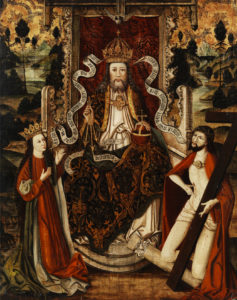
I was not impressed by these drawings. “How could God be present to the entire universe if sitting on a throne in the clouds?“ I wondered.
I also remember reading the words of the Apostle John: “No one has ever seen God” (1 Jn. 4:12). Other Bible verses speak of God being present to all creation, all at once. Early on, I doubted that God posed stiffly on a heavenly throne or lounged after hours on a celestial La-Z-Boy.
Many faith traditions insist God has no form. Some even consider drawings of God blasphemous … comic books be damned! Physical objects become idols if we consider them literally divine. While religious icons may direct our thoughts toward God, rightly understood they are not deities.
Incorporeal God
Like most theologians, I think God is a universal spirit without a localized body. Jesus put it simply: “God is spirit” (Jn. 4:24), and other biblical texts agree.
Theologians often say God is “incorporeal,” which means without a body, or “immaterial.” Because God is a universal spirit, God doesn’t have shape, height, and weight like we do.
The writers of the Bible use various words to describe the “stuff” of which God is constituted. Some compare God to breath, a mind, smoke, or the wind. None of these involve a divine body.
In recent centuries, believers have compared God to gravity, light, or oxygen. These words describe God influencing creation without having a localized physical form.
While most Christians believe God, as spirit, was specially incarnated in Jesus, they don’t think God exists essentially as a localized, physical figure.
Saying God is a universal spirit plays a crucial role in explaining why God cannot prevent the evil that creatures can sometimes prevent. (See also my essay, “The Spirit as Nonintervening and Noncoercive.”)
To put it simply, God does not have a divine body with which to block evil or rescue creatures. By contrast, creatures do have bodies to exert bodily impact on others. And creatures sometimes use their bodies to stop evil.
Let me illustrate this…
Saving You from a Monster Truck
Imagine you and I are walking along a busy street. Without looking for traffic, you step off the sidewalk onto the pavement. In doing so, you fail to notice a monster truck roaring down the street toward you. I see it and pull you from the truck’s path. Startled and unnerved, you imagine what might have happened!

Notice in this imaginary scenario, you acted freely when stepping into the street. No one forced you; no one controlled you. And notice I was able to thwart your free decision by using my body (specifically my hand). I saved you from at least severe injury and perhaps death – a loving act – by stopping your body from moving in the direction you wanted.
If it’s loving for me to prevent you from freely hurting yourself, wouldn’t it be loving for God to do the same? If I can sometimes thwart the free actions of others, why can’t God?
Saving Your Niece from the Flames
Or imagine you’re camping with family. One evening while standing around a roaring fire, your three-year-old niece marches toward the flames – of her own free will – in a flammable nightgown. Standing nearby, you grab her by the sleeve, saving her from extensive burns. Across the fire, her father sees the whole affair and thanks you profusely.

If it’s loving for you to stop your niece from freely hurting herself, wouldn’t it be loving for God to do the same? If we can sometimes obstruct another person’s free choices, why can’t God?
God Doesn’t Have a Divine Body to Stop Evil
Here’s where “God is a universal spirit without a physical body” matters.
God has no divine hand, literally speaking, to snatch us from the path of oncoming cars or grab us before entering a fire. God has no divine arms and legs to carry people from a warzone. God has no body to stand between gunmen and potential victims. God has no arms to wrap around a distraught person to keep her from cutting herself. But because creatures have localized, physical bodies, they sometimes can prevent evil.
A bodiless, universal spirit cannot do what embodied creatures sometimes can.
Acting as God’s Hands and Feet
Despite having no body, God is present and active in all situations. Divine power is direct but persuasive, widespread but wooing, causal but uncontrolling. God’s loving activity makes a difference without imposing control or using a divine body.
God calls creatures to use their bodies for good. When I pull you from the path of a truck or you save your niece from the flames, God was the loving inspiration for this good. When we respond appropriately to God, we might say we become God’s body. This isn’t literally true, of course. Cooperative creatures extend God’s activity, but they aren’t literally divine. We become God’s representational hands and feet.
Embodied creatures can also refuse to cooperate with God. Victims know this better than most. Humans and other creatures can refuse to act as God’s hands and feet. We rightly blame uncooperative creatures for causing or allowing evils God did not want.
God is a universal spirit and has no localized divine body to stop evil. But God calls upon us to use our bodies to thwart evil, when it’s possible for us to do so.
We can’t stop evil by acting alone; we need God. But God can’t stop evil without creaturely cooperation; God needs us.