
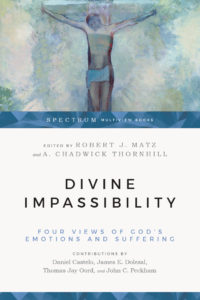
A “Four Views” book has just been published exploring God’s im/passibility (IVP Academic). I wrote one of the four essays.
Instead of “passible” or “impassible,” most people today use the words “relational” or “nonrelational” to talk about whether creatures influence God. Relational theologians like me wholeheartedly affirm the idea God engages in giving and receiving. Others makes a difference to God.
Some Think God is Not Relational
It surprises many to hear that some Christian, Jewish, and Muslim theologians from yesteryear denied God relates, in the sense of being affected by others. Thomas Aquinas and Anselm denied that God is relational, as I explained in a previous blog.
Some believers today deny that God is relational. In their view, God affects others, but others have no affect on God.
For a host of reasons — biblical, theological, philosophical, practical, ethical — I think God is relational. I have explained this in various writings, including a short blog, “What Does ‘God is Relational’ Mean?”
God is Essentially Related
In this new 4 Views book, I argue for what editors call “strong passibility.” I typically use the phrase “essentially related” instead strong passibility, but both labels reflect the view that God, by nature, relates to others.
The “weak passibility” view says God chooses to relate. God may choose to relate to some others or relate at some times. But God may choose not relate to some others or relate at other times.
God is not relational by nature but by arbitrary choice. A philosopher might say the weak passibility view assumes God contingently not necessarily relates to others.
Scripture
Biblical writers don’t explicitly endorse one version of relationality. The Bible doesn’t tell us in a direct way whether God is strongly or weakly passible. We must ponder the assets and liabilities of each view as they pertain to other issues.
In a previous blog, I explained that people who think God essentially relates — i.e., is relational by nature — have two ways they affirm their view. The first says God essentially relates within Trinity. The second says God essentially relates with creation. A third way combines the two, saying God essentially relates both in Trinity and with creation.
Believing God relates by nature has major advantages. I’ve identified elsewhere five advantages to believing God essentially relates to others.
You Probably Already Believe God is Essentially Relational
Perhaps you’ve not wondered whether God relates by choice or by nature. I suspect, however, you affirm that God relates by nature — strong divine passibility / essential relatedness — without knowing it.
To demonstrate how you probably already believe God is essentially relational, please answer the following three questions honestly. Answer in your head before reading my responses…
Q1: Do you think God could ever leave us, forsake us, or stop loving us?
Most people answer “yes” to this question. They think it’s possible for God to choose to be unrelated, unaffected, and uninfluenced. In their view, God could choose to leave us and forsake us. God could choose to stop loving us. “God sovereignly chooses to relate with and love others,” they might say.
This is the weak passibility view. It’s probably the stated (but not actual) view of most believers I know.
Let’s move to the second question…
Q2: Do you think God would ever leave us, forsake us, or stop loving us?
Most people answer “no.” They think God will always relate with us, always be present to us, and always love us. In their view, we can trust God in these crucial ways.
Those who think God could stop loving us, however, have no reason to think God would always love us. Those who think God could leave us and forsake us have no reasons to think God would never choose to leave us or forsake us. There is no justification for such views.
Let me put it another way, if God’s nature does not include love for creation, we have no reason to think God will always choose to be with us and never forsake us.
If God’s eternal nature does not include love for creation, there’s no reason to think God will always choose to love us in give-and-receive relationship.
A God who relates and loves by choice could — and perhaps has or currently does — choose not to relate and love. And that leads to the third question…
Q3: Why do you think God would never leave us, never forsake us, or never stop loving us?
Most people answer this question, “that’s just who God is.”
They say, “If God left us, forsook us, or stopped loving us, God wouldn’t be acting like God.” Or they offer a variation of these answers.
When answering this third question, most people appeal to their deep belief about who God truly is.
This deeper belief shows that people really do think God is essentially relational. Although they may not articulate it well, most think God’s love for us is an essential aspect of what it means to be God.
Saying “that’s just who God is” is really saying, “It’s God’s nature to be like that.” God can’t help but love us, because that’s God’s nature. God relates to and loves others by nature not by arbitrary choice.
Conclusion
Given these questions and their typical answers, I find most people affirm strong passibility. They may not be able to articulate this affirmation. They may even say God chooses to relate and love.
But when pressed, most people I know think it’s God’s nature to relate to and love others.
[1] See my arguments in The Uncontrolling Love of God: An Open and Relational Theory of Providence (Downers Grove, Ill.: Intervarsity Academic, 2015) and various essays in Uncontrolling Love: Essays Exploring the Uncontrolling Love of God with Introductions by Thomas Jay Oord, Chris Baker, Gloria Coffin, Craig Drurey, Graden Kirksey, Lisa Michaels, and Donna Ward, eds. (San Diego, Ca.: SacraSage, 2017).