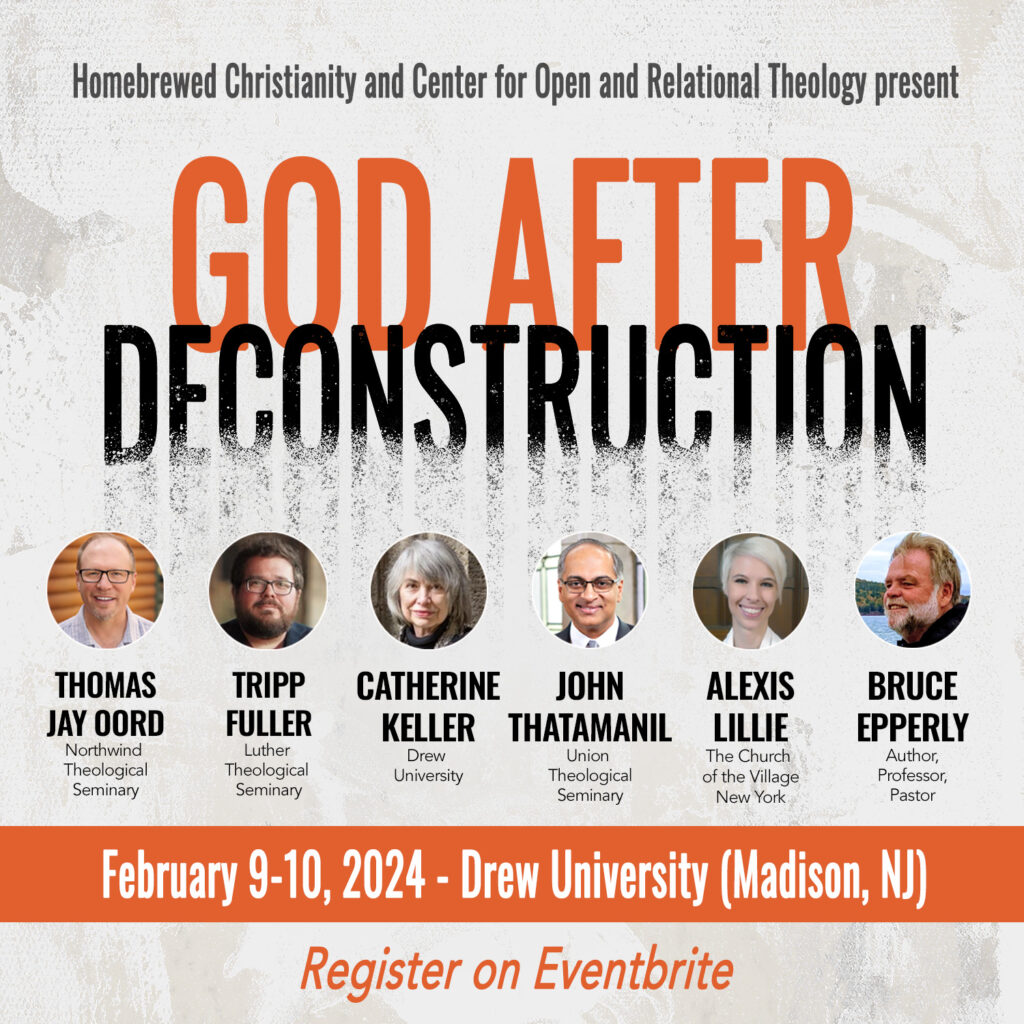
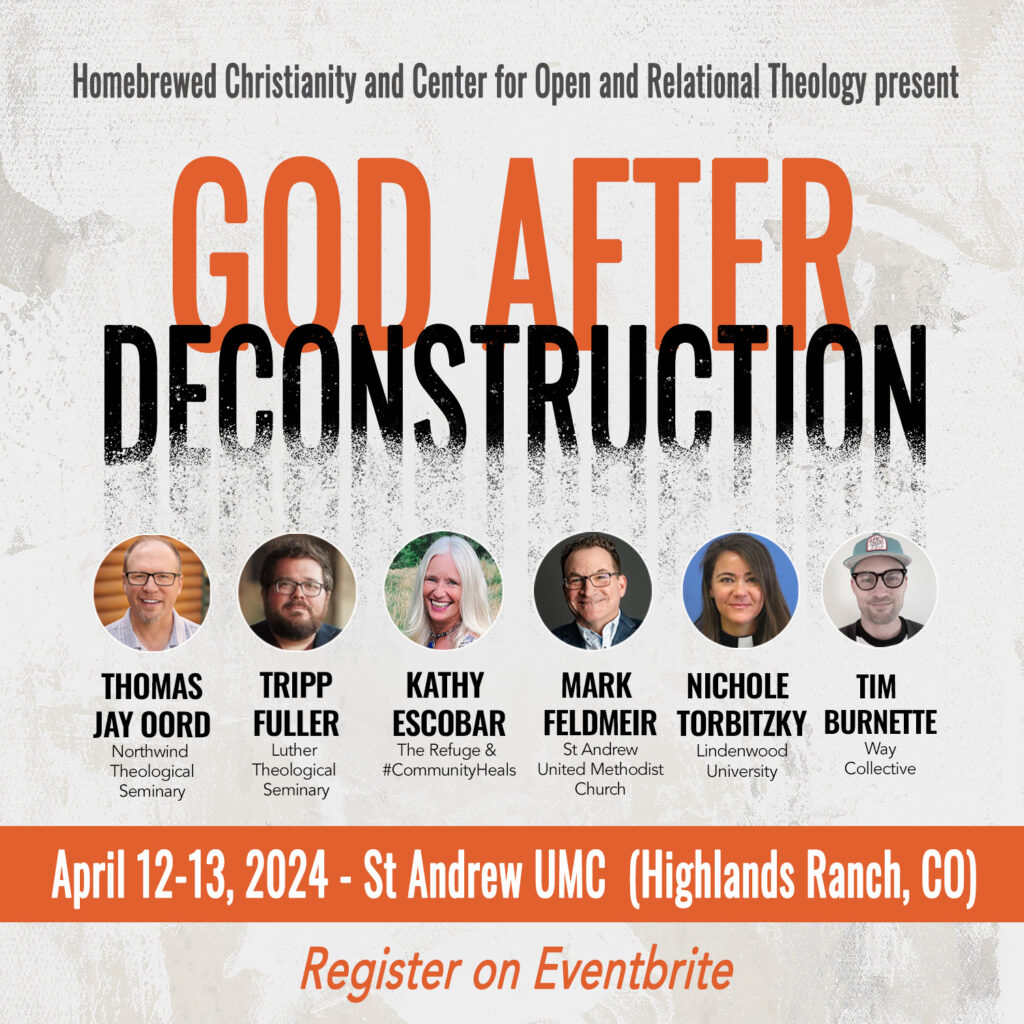
Tripp Fuller and I are writing a book, doing a podcast class, and holding an in-person lecture tour on the theme, “God After Deconstruction.”
The first two tour events are coming soon. Find info here for the Drew University event this February 9-10 and the Denver, Colorado event this April 12-13. For information on how to participate in the online class, see this link.
In this blog post, I’m sharing a snippet from the God After Deconstruction book. We’d love to get your feedback!
Evil Leads to Deconstruction
No issue leads more people to deconstruct than the problem of evil. According to polls, questions about suffering are the primary reason some choose atheism and others are agnostic. For many, evil kills belief in God.
Questions about evil lead many who remain believers to be confused or apathetic. Why doesn’t a loving and powerful God prevent genuine evil? If God doesn’t make the effort, why should I? Evil stumps believers too.
Rachel Held Evans describes the questioning process concisely: “First, I doubted God was good. Then I doubted He was real.” (Rachel Held Evans, Monkey Town) Rachel’s reasoning makes perfect sense if one assumes that God can prevent harm but doesn’t. A loving and omnipotent God would stop pointless pain.
Those who believe in God often address questions of suffering from the perspective of the perpetrators rather than the victims. “God wants us to exercise free will,” say some, “and our misuse of freedom is the price God chose to pay for free relationships.” Rarely are the relationships, free will, or well-being of victims considered. Doesn’t God care about them?
“We wouldn’t know good if there wasn’t evil,” say others. Perhaps this is true, but we don’t need so much evil to know the difference. Besides, most Christians believe in an afterlife of pure bliss. If we can’t appreciate good without evil, there must be oodles of evil in heaven!
Excuses for why a good God doesn’t stop evil lead many to deconstruct.
God is in Control?
“I announced on Facebook I was joining the deconstruction movement,” wrote Calvin. “I was in complete free fall; I posted a meme of Wile E. Coyote hanging midair. The Bible, hell, salvation, and more were all in limbo. Even the existence of God.”
The problem of evil was Calvin’s primary issue. “A God who allowed the Holocaust to happen for any reason didn’t exist. Couldn’t exist. I found the usual responses to questions about God and evil unsatisfying. If God could stop evil and didn’t, He is diabolical. That God didn’t love us. I was pulled towards agnosticism or atheism.”
Others who deconstruct share Calvin’s experience. “The notion of an omnipotent God of love rang false in the face of my direct experience of shaming and abuse in my home,” says Marva. “I asked for bread and was given the equivalent of stone, all while managing appearances in our church community.”
Hannie said that for her, it all started with a question: “If God is love, how come all this trouble in my life?” She continues, “I did not have a loving upbringing, and my parents were strictly religious. So the answers I received to my question centered on hell, the cross, the devil, and the Old Testament. Eventually, those made no sense.”
“’God has a plan for this’ was the repeated phrase for any catastrophe,” says Jeff. “That phrase sounded less like faith in God and more like a determinism that erodes any sense of human freedom. I lost interest… and hope.”
Mary-Anne puts it succinctly: “If God allows evil, I’m often more loving than He is.”
The Allure of Omnipotence
Most people believe God can do anything. “Omnipotent” is the philosopher’s word for this, although many believers prefer “sovereign,” “almighty,” or “all-powerful.” Most think God can singlehandedly bring about any result that’s logically possible. “God is in control,” they say, and the Almighty guarantees at least the outcomes that really matter.
Believing in an omnipotent God offers to some a sense of security. “An all-powerful and good deity would only allow pain that benefits us,” they say. What we think is evil, goes the argument, is actually positive from the divine perspective. It’s part of a Plan or the collateral damage needed for a functioning universe. Suffering is required for greater good.
The idea God causes or allows horrors does not assure and console most survivors, however. Some think God abandoned them when they most needed rescuing; others assume pain is divine punishment. Saying to victims, “God chose not to take away your abuser’s free will,” sounds like God values the harmer’s freedom more than rescuing the harmed.
Priests, pastors, and politicians sometimes appeal to omnipotence to justify power grabs. A sovereign God ordained their authority, they claim. How convenient! If God is all-powerful, however, it’s hard to argue against them. An omnipotent deity installs or permits the tyranny of every power-hungry demagogue.
Some Christians think an omnipotent God is the only hope that right eventually triumphs over wrong. Only an all-powerful deity can guarantee justice. While things are bad now, they say, we must believe the Sovereign One works all things for some foreknown good.
The omnipotent One who can win at a later date, however, could also win now. After all, nothing can stop omnipotence. Rather than preventing pointless pain, an all-powerful deity permits it. That’s not love! Besides, who wants to spend eternity with Someone who allows the rape, destruction, and torture He could have prevented singlehandedly?
We shouldn’t trust an omnipotent Bystander.