
We all want to make sense of life. The stakes for Christians in the endeavor to make sense of life are as high as stakes can be.
I’ve been thinking for some time about two major questions in my quest to make sense of life. The first is familiar to just about everyone, at least in some form. Here’s the form I find most perplexing:
“If a loving and powerful God exists, why doesn’t this God prevent genuine evil?”
The vast majority of answers given to this question are unsatisfying. Most Christians I know ultimately appeal to mystery. This question perplexes billions of people. 
The second question is less common but I think equally perplexing:
“How can a loving and powerful God be providential if random and chance events occur?”
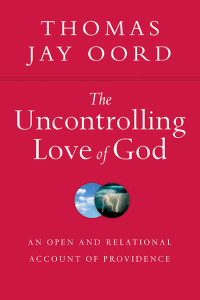
In my new book, The Uncontrolling Love of God: An Open and Relational Account of Providence (Intervarsity Press Academic), I propose answers to these questions. Theology, science, Scripture, and philosophy inform my answers. Unlike most Christians, I don’t appeal to mystery!
I’m happy that the book is now ranked #1 on two Amazon lists for new releases! Click the photo to watch a short video/trailer I made to introduce the book.
The Issues at Play
To get at my answers, I address a wide swath of issues that Christians normally consider aspects of God’s providence. I address the randomness and chance we encounter in the world. I claim that randomness is real, even for God.
I also acknowledge the rampant regularities of life, some of which have been called “the laws of nature.” Thinking carefully about God’s relationship to these law-like regularities is important for solving the problem of evil and the problem of randomness in relation to providence.
In my view, too few Christians take free will seriously when thinking about providence. I believe the freedom we experience in life is real, but limited. I’m a freewill theist.
I also think values are real. Some events are better than others. Good and evil are not simply a matter personal taste or individual perspective. A portion of my book addresses how we should define evil and why belief in God makes better sense than atheism. In this section, I also address the problem of good, which I think is an issue atheists cannot handle well.
Models of Providence
Of course, I’m not the first person to recommend a particular view of God’s action in relation to creation. A number of models of providence exist. It helps to get clear on these models if we can make progress in answering well the problem of evil and the problem of randomness.
I identify seven major models in my book, pointing out strengths and weaknesses of each. I think this part of the book is especially helpful for getting one’s head around the various ways to think about providence.
I’m an open and relational theologian. This form of theology comes in many varieties, but there are some common characteristics. People have come to embrace open and relational theologies from various paths. Some come primarily through their study of Scripture. Others by working out issues in the discipline of theology. Some come to open and relational theology through philosophical reflection. And others come as a consequences of their study of science.
God Allows Evil?
The most common answer to the problem of evil and the problem of randomness, even among many open and relational theologians, is that God allows evil and randomness. God could control it but chooses not to do so.
I don’t find the “God allows it” answer satisfying. God cannot be perfectly loving if God allows evil and permits random events that God would anticipate have negative consequences. We don’t think people are perfectly loving when they allow horrific evils they could have stopped. Why think that God is loving for doing the same?
[Tweet theme=”basic-full”]I don’t find the “God allows evil” answer satisfying.[/Tweet]
Many who say God allows evil and permits randomness say God voluntarily self-limits. God could intervene to prevent evil. God could stop a random event that will likely have negative consequences. But for some mysterious reason, this voluntarily self-limited God doesn’t momentarily become un-self-limited to prevent genuine evil. The problem of evil is a problem for many open and relational theologies.
 Essential Kenosis Model of Providence
I offer a new open and relational model of providence I call “essential kenosis.” It says God’s love is always self-giving, others-empowering. God must love because God’s nature is love.
Unlike many open and relational theologians, I believe God’s nature of self-giving, others-empowering love conditions and shapes God’s sovereignty. To put it in philosophical language, divine love is logically prior to divine power. This means that God’s self-limitation is involuntary, because God’s nature of love limits what God can do.
In short: God can’t prevent genuine evil by acting alone and God can’t stop random events that produce evil.
To put in biblical terms, I think the Apostle Paul was right when he said that God “cannot deny himself” (2 Tim. 2:13). In other words, God’s nature comes before God’s choice, and God cannot do that which is ungodly. Teasing out the implications of this can make all the difference for answering well the perplexing questions of our time.
Of course, there are much more to this book than what I’m offering here. I haven’t even mentioned my explanation of miracles, which gets a whole chapter in the book.
I hope you consider ordering The Uncontrolling Love of God and pondering my arguments!
[Tweet theme=”basic-full”]Love is logically prior to power in God’s nature.[/Tweet]