
Most present-day Christians treasure the Bible. I know I do. But differences of opinion exist among Christians about how best to understand and engage Scripture.
For most of history, the typical Christian was unable to read the Bible. Many were not taught to read. Even more had no access to a Bible. Not until long after the printing press was invented were typical Christians able to own a Bible of their own. Many heard only heard the Bible read aloud in a language they did not know (e.g., Latin).
In the United States and many other countries today, however, Bibles are common. I must own a couple dozen, and I’ve probably been offered a hundred or more free Bibles over my lifetime. I’ve had the privilege of studying the Bible with the help of various translations, commentaries, reading the original languages, and the benefit of the best theological education.
As I think about how I treasure the Bible, I find myself returning often to five basic questions. The answers I’ve given these questions have varied over my life. 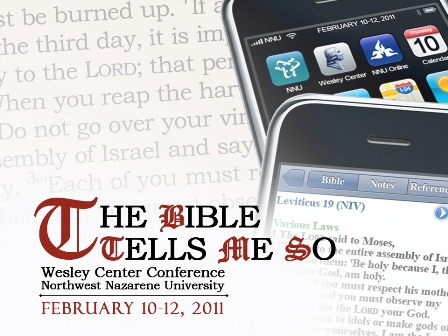
These questions form the heart of The Bible Tells Me So conference I’m directing in early February. I thought I’d pose the questions in this blog to help those who plan to attend the conference think about how they might answer them. And I’d like to get responses from those who cannot attend The Bible Tells Me So conference but want to offer here answers or insights they find helpful.
1. What does it mean to say the Bible is inspired?
Every Christian I know believes God inspired the writing of the Bible. Part of the reason Christians believe this is that the Bible says in a few verses that God inspired biblical authors. The most common passage expressing this is 2 Timothy 3:15-17.
What it actually means to say God inspired the writing of the Bible, however, is a question with various answers. Some either implicitly or explicitly say God dictated all of the words so that what was written is precisely and totally what God wanted. This dictation theory suggests that the writers acted like machines or robots with none of their own thoughts and creativity contributing to the writing process.
Most in the Wesleyan theological tradition have rejected this dictation theory of inspiration. It doesn’t seem to line up with what the biblical authors actually say about their role. And it doesn’t fit with the way in which we see God inspiring people today. With H. Orton Wiley, these Christians talk about dynamical, cooperative, or symbiotic inspiration, whereby human authors contribute with the God in the writing of the Bible.
Many scholars today argue that the more important question is not “How was the Bible inspired by God,” but “How is God inspiring us to read the Bible today?” This shifts the focus from past tense to present tense. I’ve written some about this in previous blogs.
2. On what questions is the Bible a trustworthy guide?
Christians believe the Bible provides truths. The Bible can be trusted as a helpful guide in helping us answer at least some questions.
I have yet to meet someone who, when pressed, says the Bible answers all our questions. When my daughters ask math homework questions, for instance, I don’t open my Bible to find the answers. The Bible can’t give me all the answers to the Kennedy assassination. Nor can I rely on it to predict the 2011 Super Bowl champion.
So what kind of guidance does the Bible give? In the Wesleyan tradition, scholars have said Scripture at least gives us truths God uses to lead us to salvation. There is debate, however, about whether the Bible is trustworthy on all matters of science, history, and culture.
For instance, to what extent do Genesis creation narratives tell us scientific truth? When the Bible talks about the four corners of the earth, should we believe that round planets have four corners? Or should we interpret these and other biblical passages as metaphorical or theological and not scientific?
3. Is the Bible without error?
While Christians in the distant past thought occasionally about this question, the question of biblical inerrancy has been often debated in the last century. The worry has been that admitting to even one biblical error or inconsistency leads to lack of trust on the Bible as a whole. And if God inspired the Bible, an error-free God must have delivered an error-free product.
Answering this question is trickier than one might first imagine. I’ve written a few blogs on the subject, and the responses illustrate that this issue remains hot! See this and this.
The major question is “What constitutes a biblical error?” Answering this question requires interpretation and looking at contexts. Some people list as errors what I think are simply uncharitable and even nonsensical readings of the Bible. Here’s one recently published list (you have to read the small print) of alleged errors in the Bible. The vast majority of those listed are unconvincing, however, because they fail to account for the biblical contexts or treat as literal what seems to be intended as metaphorical.
But other lists of inconsistencies and biblical errors have led biblical scholars to reject what I call “absolute inerrancy,” which is the view that the Bible is without any errors whatsoever. The vast majority of Wesleyan biblical scholars do not accept absolute inerrancy.
If we reject absolute inerrancy, however, we face questions about how we decide which passages have inconsistencies or errors and which do not. Some worry this discerning exercise leads to insurmountable problems and becomes subjective. Others argue that the discerning process is necessary because they cannot honestly affirm absolute inerrancy given the biblical text itself.
4. How should we interpret the Bible?
Amid debates about inerrancy, what many think is a much more important question sometimes gets overlooked: How do we go about interpreting the Bible?
Ironically, two people who argue the Bible is absolutely inerrant can come to vastly different interpretations about what a particular biblical passage means. At the end of the day, isn’t figuring out what the Bible means the most important issue when trying to learn about God and how we ought to live life?
Part of the interpretation problem revolves around who gets to decide which interpretation is best. On the one hand, I want to say the Holy Spirit can teach truth to anyone who prays and reads the Bible. But what happens when those who pray and read the Bible come to interpretations that the majority believes violates the plain meaning of Scripture? And what happens when a minority interpretation lead to destructive behavior the individual claims that God endorses? The “individual interpretation” approach has real limits.
On the other hand, I want to say that we should listen to and trust those who have studied and been educated in the intricacies of Scripture. This means trusting the scholars. But I also know that scholars often disagree with one another. And I worry that “waiting for scholarly consensus” on how to interpret a passage can sometimes suck the fervor from the desire to seek a word from the Lord through reading the Bible. Besides, sometimes experts are wrong. The “expert’s interpretation” approach also has limits.
In short, who do we trust to interpret the Bible rightly? Do we rely on individual interpretation? Scholarly interpretation? Interpretations from our pastor or famous Christian leaders? Our community’s or theological tradition’s interpretation? The Pope’s interpretation?
5. Does postmodernism influence the Bible?
The final question Christians face is the question of cultural and ideological influence on the Bible. We often call such current influence “postmodernism.” This word has many meanings. But at its heart is the intuition that changes have occurred that affect the way we view reality.
For some, this question is the most threatening of the five I’ve listed. Such people can’t imagine how any change in worldview should influence how we understand the Bible.
But a glance at history reveals that cultural and ideological influence has always affected the way Christians approach Scripture. For instance, there is no doubt that the translation and interpretation of the Bible has changed over the centuries. The Latin Vulgate translation of the Bible is different from King James Version. And those two are different from the New International Version, New Revised Standard Version, and newer translations like the Common English Bible.
Those who translated these versions of the Bible were influenced by their culture and worldviews as they chose words to use when translating the Bible from ancient manuscripts. And because more old biblical manuscripts have been discovered over the centuries, more ancient manuscripts were available for contemporary translators than were available for older versions of the Bible.
Of course, postmodern culture and ideology also likely influences how we interpret the Bible today. Most of this influence is probably unconscious. But I think with a little reflection, we realize that most people interpret some parts of the Bible differently today than most people interpreted the Bible in the past. For instance, I have no doubt that postmodern people read references to slavery differently than Christians five hundred years ago. And people today often think about biblical references to women differently than even 100 years ago. The times change, and these changes influence how we read and interpret the Bible.
Prayerful Conclusion
These five questions are deep. They are complex. And I think they are extremely important for educated Christian leaders to ponder. They will be the fodder for several discussions at The Bible Tells Me So conference.
We will conclude the conference by offering answers to these questions. The answers won’t come from me, however. They will come from the conference consensus. Those who attend will answer them, and these attendees include pastors, biblical scholars, lay leaders, theologians, students, and others.
I come to The Bible Tells Me So conference in an attitude of hopeful prayer. My hope is our loving and mighty God. My prayer is that God will lead those who attend, those who watch the conference live online, and those who only hear of what occurs to listen closely to what the Spirit wants to teach us all. My hopeful prayer is in the God who seeks to convince everyone of the truth of salvation.
Would you join me in hopeful prayer for The Bible Tells Me So conference?