
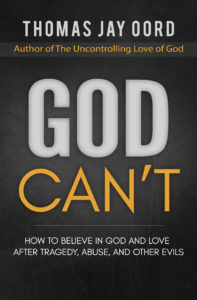
My recent book, God Can’t, makes the claim God can’t do some activities. Although this strikes some as unprecedented, John Wesley said it before I did.
God Can’t in the Bible
Biblical writers said “God can’t” before John Wesley and me. In various books and blogs, I’ve listed biblical passages that explicitly say God can’t do some actions. For instance, God can’t lie, can’t be tempted, can’t grow tired, can’t sin, can’t stop existing, etc.
The passage I like best is found in the Apostle Paul’s letter to Timothy. Paul says, “When we are faithless, God remains faithful, because God cannot deny himself” (2 Tim. 2:13). God cannot act in an ungodlike way.
Other Theologians say God Can’t
In addition to biblical statements about what God can’t do, most Christian theologians say God can’t do what is illogical. God cannot make a round square, for instance.
Many also say God cannot do what is self-contradictory. God cannot both exist and not exist, for instance. God cannot both be perfectly loving and perfectly sinful. And so on.
C. S. Lewis put it this way, “Not even Omnipotence can do what is self-contradictory.”
Wesley’s Provocative Claim
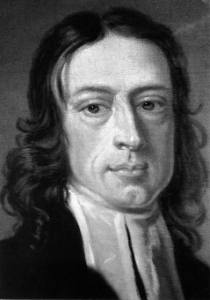
In his sermon on providence, John Wesley tackles the difficult questions about God’s action in the world. At one point in the sermon, he writes this:
“Were human liberty taken away, men would be as incapable of virtue as stones. Therefore (with reverence be it spoken) the Almighty himself cannot do this thing. He cannot thus contradict himself or undo what he has done.” (On Divine Providence)
Notice that Wesley says “cannot.” He doesn’t say, “chooses not to.” These activities are simply not possible for God.
Wesley Says God Can’t Do Three Things
Wesley makes three claims in this quote: 1) God can’t take away freedom, 2) God can’t contradict Himself, 3) God can’t undo what has been done.
The first idea is increasingly accepted among Christian philosophers and theologians: God cannot undermine the freedom that creatures express. In my view, God necessarily gives freedom, agency, and self-organization, which is why God can’t withdraw, override, or fail to provide these.
The second idea says God cannot contradict God’s own nature. This fits nicely with the Apostle Paul’s claims about God not being able to deny himself. God can’t decide not to be God.
The third idea refers to God’s inability to change what God has enacted. What’s done is done. Reverse causation is a myth. God works to redeem the past, but that’s not the same as changing it.
God Can’t Prevent Evil Singlehandedly
The central claim of God Can’t is that God loves everyone and everything. And because God’s love is inherently uncontrolling, God cannot control anyone or anything.
So… God can’t prevent evil singlehandedly.
Victims and survivors of evil find the God Can’t message comforting. They no longer believe their pain was caused or allowed by God. They don’t have to believe God abandoned or punished them. Confusion disappears.
The belief that God can’t control others means God is not culpable for failing to prevent evil. God can call upon us and others, however, to cooperate in overcoming evil and promoting love. Although God can’t prevent evil singlehandedly, God can prevent evil when creatures cooperate with the ways of love.
Conclusion
I make five claims in God Can’t that together solve the problem of evil. I believe we need these ideas – as provocative or unfamiliar as they may be – to make sense of God’s love for us all.