
A vegetarian butcher. That’s the combination some people think analogous to being both a scientist and theologian.
Yet John Polkinghorne is just that: a physicist and a priest. Combining the two in one person is likely to arouse curiosity and perhaps suspicion.
Polkinghorne believes that together, both science and theology provide a particularly good vision of the world. Like the two scopes of a binocular working in tandem to improve vision, science and religion offer essential perspectives for the great quest for truth.
Polkinghorne earned a Ph.D. in physics from Cambridge University about 50 years ago. He titled his first book about particle physics, The Particle Play. The book “gives an account of where we had found ourselves when the dust had finally settled on that phase of particle physics during which I had been an active participant,” Polkinghorne reports. A second book, Quantum World (1984), has proven the bestselling of the more than thirty-five volumes he has penned.
After almost two decades of research and teaching in physics, Polkinghorne decided to prepare for ordained Christian ministry in the Church of England. “I simply felt that I had done my little bit to particle theory,” he explains, “and the time had come to do something else.” The transition from working physicist to burgeoning priest led Polkinghorne to pen his newly forming ideas about the relationship between his Christian faith and science.
Cambridge invited Polkinghorne back to serve as the Dean and Chaplain at Trinity Hall. After a short period at Trinity Hall, however, Queens’ College at Cambridge elected him as its president. He finished his career as in this capacity and retired in 1996.
Polkinghorne has been a prolific interdisciplinary author. This kind of writing “requires a degree of intellectual boldness and a degree of intellectual charity,” he says. “I strive to be two-eyed, looking at both with the eye of science and with the eye of religion, and such binocular vision enables me to see more than may be possible with either eye on its own.”
This double focus also leads to a double mission. “On the one hand,” says Polkinghorne, he tries in his writing “to encourage scientists to take religion seriously and not dismiss it unreflectively without a hearing.” On the other hand, he tries to “encourage religious people to take science seriously and not to fear the truth that it brings.”
The vision of God, c reatures, and the world Polkinghorne offers makes possible a genuine conversation between science and theology. “If I can act in this way in a world of becoming that is open to its future,” argues Polkinghorne, “I see no reason to suppose that God, that world’s Creator, cannot also act providentially in some analogous way within the course of its history.” This suggests that God provides some freedom and agency to creatures. “God interacts with creatures,” he explains, “but does not over-rule the gift of due independence with which they have been given.”
After an illustrious career of teaching, lecturing, and writing, John Polkinghorne has been awarded a variety of honors. In 1993 and 1994, he was invited to give the Gifford lectures at Edinburgh University. He chose to concentrate most of his lectures defending the cogency and fruitfulness of the Christian Nicene Creed. He was awarded the Templeton Prize in 2002. He plans to celebrate his 80th birthday this coming October.
When I think about John Polkinghorne’s research at the science and Christian theology interface, I am reminded of the words of the Apostle Paul. He wrote to Christians in Rome that “what made be known about God is plain to them, because God has shown it to them. Ever since the creation of the world his eternal power and divine nature, invisible though they are, have been understood and seen through the things he has made” (Rm. 1:19-20; NRSV).
I have been so impressed with Polkinghorne’s work that in the summer of 2007, I approached John with an idea. I suggested bringing together som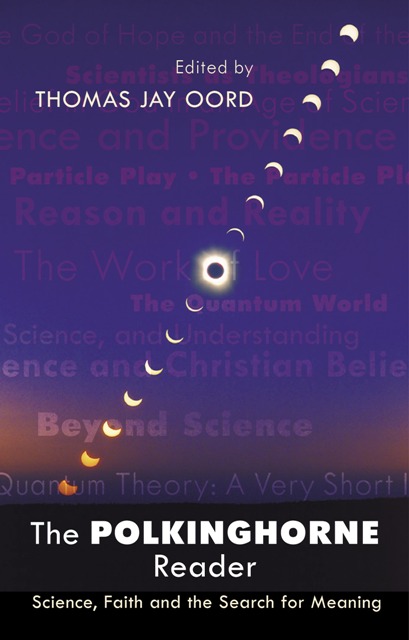 e of his best material in various small books. He agreed that the project needed to be done. I proposed that we work together to construct a Polkinghorne reader. I am grateful to Templeton Press and SPCK who agreed to co-publish the resulting book I edited, The Polkinghorne Reader: Science, Faith and the Search for Meaning. It will appear in print this summer.
While I was confident that a book drawing together some of the best from John’s books would be attractive to those who ponder issues in science and theology, I was equally confident that having John select the various excerpts for the book would be vital. In editing this book, therefore, I relied heavily upon John’s own preferences for what should be included. The result is a book that presents some of what John himself considers the best of his wide-ranging contributions to the field.
I have noticed a few websites already advertising The Polkinghorne Reader. I will post a link to one of them when the book is ready for pre-ordering. I plan to present a copy to John as a gift for his 80th birthday.