
The Bible functions as key resource for helping me understand something about God and about life in general. But the errors I have discovered in the Bible prompt me to take care in how I think and talk about Scripture.
As a young person, I wanted a clear and unambiguous foundation to speak truthfully about God. This desire shaped the way I viewed the Bible. It seemed obvious that I should affirm the Bible to be absolutely inerrant: I wanted the certainty inerrancy seems to provide. I thought I needed an inerrant book to battle the errors I encountered in life.
Absolute biblical inerrancy makes sense. It makes sense, that is, if we begin with a particular view of biblical inspiration and a particular view of God. I had these views as a youngster.
If God can do anything and if God truly loves us, God would apparently want to deliver an absolutely clear and inerrant written revelation. Therefore, the Bible must not have any errors whatsoever. This was my view of the Bible as a young person.
Then I started reading the Bible carefully.
Instead of a crystal-clear, unambiguous, and inerrant biblical text, I found ambiguity and errors of various sorts. Through careful study and conversations with biblical scholars, I found no strong reason to continue to regard the Bible as absolutely inerrant.
[Tweet “I find no strong reason to continue thinking the Bible is absolutely inerrant.”]
I could not deny the Bible itself. It has errors. I could not honestly say otherwise. To be honest with myself, therefore, I had to admit the Bible contained errors.
Errors in the Bible
Let’s consider just these ten errors in the Bible:
1. Jesus curses fig tree and it withers immediately (Matthew 21:18-20). Jesus curses this same fig tree and it does not wither immediately. The disciples observe it withered the next morning (Mark 11:12-14; 20-21).
2. Mark records Jesus as quoting from Isaiah (Mk. 1:2), when the words are actually from Malachi (3:1).
3. Matthew records a quote and credits it to Jeremiah (Mt. 27:9), when the majority of the quote is actually found in Zechariah (11:12, 13) not Jeremiah.
4. Jesus heals one demon-possessed man (at Gerasenes/Gergesenes/Gadarenes) and sends the demon into the pigs (Mark 5:1-20). But in Matthew’s story of the same event, Jesus heals two demon-possessed men (at Gerasenes/Gergesenes/Gadarenes) and sends the demons into the pigs (Matthew 8:28-34).
5. Most Bibles have no verse 24 of Romans chapter sixteen. The text skips from verse 23 to verse 25. Some kind of error occurs here.
6. Those that died in Numbers 25:9 are 24,000; whereas 1 Corinthians lists 23,000 for the same event.
7. Jesus tells the disciples to take a staff on their journey as recorded in Mark 6:8, but Matthew records Jesus as telling the disciples not to take a staff on that journey (10:9-10).
8. 2 Samuel says that God incited David to take a census (24:1-2); 1 Chronicles says that Satan induced David to take that census (21:1-2).
9. Matthew quotes Jesus as saying that the mustard seed is the smallest of all seeds (13:31-32). However, the mustard seed is not the smallest of all seeds.
10. Matthew says that Judas hanged himself (27:5), while the writer of Acts says that Judas died after falling headlong and bursting open (1:18).
This is only a short list of biblical errors or inconsistencies. This list is sufficient to make my point, however. After all, any difference, inconsistency, or error would mean that we could not strictly call the Bibles we read absolutely “inerrant.”
I’ve found many more errors in the Bible since my youth. I’m not saying that most of the Bible is entirely false. That isn’t the case. But I also want to be clear that a significant number of errors exist. Honesty demands that I be frank about this fact.
Missing Autographs and Divergent Manuscripts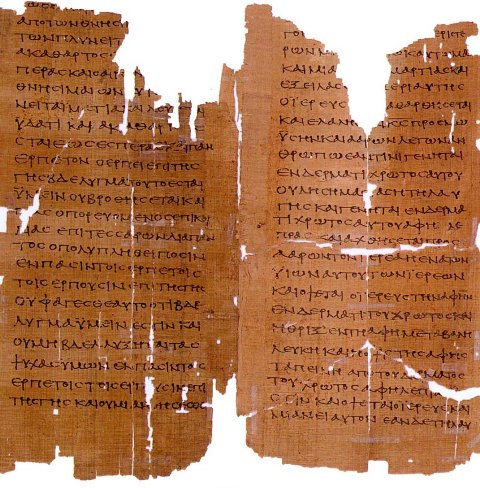
The errors I’m talking about here don’t even include the significant differences in the oldest biblical manuscripts from which we derive our current Bibles. Many Christians don’t know that the Bibles we read today did not come directly from original manuscripts or “autographs.” Those originals no longer exist. We only have copies penned many generations after the originals.
In fact, scholars over the centuries have translated various bits and pieces of ancient Bibles to construct the Bibles we read today. These bits and pieces were copied centuries after the Bible was originally written.
In addition, those ancient manuscripts from which our Bibles come sometimes differ. Most differences are minor. But some are of greater importance.
For instance, look at the end of Mark’s gospel. Some ancient manuscripts end at verse eight of the last chapter. Other manuscripts include verses nine through twenty. Even others include an extra verse after verse fourteen.
Or take the story of the woman caught in adultery. This story is usually located in John 7:53-8:11 in our contemporary Bibles. But the story itself is not included at all in most ancient manuscripts. Those old manuscripts that do include the story place it in varying places in the Gospels. If it were a matter of only including material from the oldest manuscripts available, the story of the woman caught in adultery would not be included in our bibles today.
It’s very difficult to claim the Bibles we read are inerrant when we realize the earliest manuscripts have differences. The big differences I mentioned obviously create problems. But even a slight difference between two ancient manuscripts – say, the difference between one having the word “for” and the other “with” – creates a problem for those who affirm absolute inerrancy. At the micro level, we find many errors and inconsistencies.
When some people raised in an Evangelical Christian community realize that the Bible has errors, they feel forced to make a choice. They can either ignore these errors and continue to claim absolute biblical inerrancy despite overwhelming evidence to the contrary. Or they can reject the idea that God had anything to do with the writing of the Bible.
 Wesleyan Approaches to the Bible
Fortunately, the theological tradition in which I live and affirm – the Wesleyan tradition – has important tools for overcoming the problem of errors in the Bible. It allows one to avoid choosing either of the two alternatives. It provides the basis for a third option. Let me note three tools from the Wesleyan tradition I’ve found especially helpful for making sense of errors in the Bible:
[Tweet “The Wesleyan tradition has tools for overcoming the problem of errors in the Bible.”]
Symbiosis not Dictation — Instead of thinking of God’s inspiration as involving unilateral dictation to the biblical writers, my tradition argues that the writing of the Bible involved both God and humans. God inspired humans, but humans – who are error-prone and not omniscient – wrote what they believe God wanted. I call this model of biblical inspiration “symbiosis.” God acts first to inspire the writing of the biblical text, but the writers respond to God in their finitude. (By the way, this symbiosis principle also applies to biblical interpretation.)
God Gives Freedom — God does not exercise the kind of stifling sovereignty necessary to deliver a manuscript absolutely free from error. Instead, God lovingly created and continues to create free creatures – including biblical authors with freedom of their own. Because of the freedom God lovingly gives us all, creaturely errors in knowledge and action are possible.
Salvific Inerrancy — The main point of the Bible is to help us find salvation. Scripture need not be completely error free for God to use it in this way. Instead of claiming absolute inerrancy, many in the Wesleyan tradition affirm what I call “salvific inerrancy.” The Church of the Nazarene, for instance, affirms salvific inerrancy when it believes the Bible “inerrantly revealing the will of God concerning us in all things necessary to our salvation.” John Wesley puts it this way: “The Scriptures are a complete rule of faith and practice; and they are clear in all necessary points.”
I believe God uses the Bible as an instrument to invite creatures to salvation. This instrument need not be perfect in all ways to be useful. The Bible need not be absolutely inerrant for God to use it to invite us to salvation.
Given these Wesleyan tools, I have more respect for the Bible today than I had as a youngster. Although I no longer think of it as completely error-free, the Bible is my principal authority for matters of salvation. I cherish the Scriptures and trust God to use them to teach, rebuke, correct, and train me in righteousness (2 Tim. 3:16).
[Tweet “The Bible need not be absolutely inerrant for God to use it to invite us to salvation.”]