
“The finally impenitent are hopelessly and eternally lost.”
The Manual of the Church of the Nazarene includes these ominous words. The phrase “the finally impenitent” was in use prior to the denomination’s beginning. And other Christian groups currently include these words in their belief statements.
“Impenitent” refers to those who do not repent from sin to embrace God’s love. “Hopeless and eternally lost” can be interpreted variously. Many consider the phrase a reference to eternal conscious torment in hell. But being “lost” can mean other things, and biblical writers refer to “lostness” in various ways.
Finally?
I’ve been thinking about the word “finally.” How and when are the impenitent “finally” unrepentant?
I suspect most people think “finally” comes at a person’s death. But this raises many questions.
Do those who have near-death experiences have more than one “finally?” Are those pronounced dead but are later revived spared of “finally?”
Might “finally” come before our bodies die? Can one become finally impenitent at age 5? 12? 25? 55? 99?
Do we get another chance in the afterlife? Is purgatory the process of coming to a “finally impenitent” moment?
When is “finally?”
Does God Give Up?
Even more important is this question: Would an everlastingly loving God decide some people are “finally impenitent?”
Does God say, “Well, I’ve given her 44,837 chances to repent? This next one is the final one?”
Or does God say, “He’s done so many unrighteous acts that I will not resurrect him?” Or “I’ll resurrect her but then annihilate her after judgment?”
I don’t think God ever gives up.
I can’t believe that the God who “gives up” on anyone could be a God of steadfast love. This God does not always forgive. This God does not always turn the other cheek. The love of the God who gives up is love that does not endure forever.
A God who annihilates or sends some to eternal conscious torment is not a God of perfect love.
Universalism?
The phrase “the finally impenitent are hopelessly and eternally lost” does not rule out universalism or the ultimate redemption of all things. We have grounds to hope all will be reconciled.
“Universalism” comes in many forms. Most think of it in terms of a sovereign God accepting all creatures (and all creation?) into eternal bliss or heaven. This accepting God annihilates no one and sends no one to hell.
The universalist view says God forgives us no matter what we’ve done, and we will enjoy everlasting life beyond bodily death.

(For an accessible defense of universalism, see Jesus Undefeated, by Keith Giles. For a much less accessible case for universalism, see That All Shall Be Saved, by David Bentley Hart. Brad Jersak has written a strong biblical appraisal of universalism in Her Gates Will Never Be Shut.)
Problems with Universalism
The usual views of universalism have problems.
First, they ignore the freedom of those who do not want to be with God for eternity. The common view of universalism says, “You may want something else, but you have to embrace the ways of heaven… even if you don’t want to.”
Second, if God has the power to force some into eternal bliss against their will, this God would have the power to prevent evil against the will of those who do evil. The God who can control later has the power to control now… and thereby prevent the genuine evil we experience. And yet we endure genuine evil.
Third, if eternal life in heaven is inevitable for all – no matter what we do – how do our lives matter? Our choices have no ultimate significance if God will rescue us despite ourselves. Our decisions become ultimately meaningless.
Fourth, what real incentive might we have for avoiding evil, fighting corruption, fighting climate change, etc. if none of our efforts ultimately matter? If God sends everyone to eternal bliss, what’s the point of self-sacrifice in the present?
A Better Way
I think there’s a better way to interpret the phrase, “the finally impenitent will be hopelessly and eternally lost.”
This better way says God never gives up calling us to love. God never gives up while we live in these bodies. And God never gives up in the afterlife. God’s steadfast love literally endures forever!
It also says, therefore, that God does not annihilate or send anyone to hell. God never acts to kill or torment. God is not a punisher.
This better way says God doesn’t force anyone into a loving relationship. God always calls, empowers, and inspires us to love. But we can resist, refuse, or not cooperate. And God won’t – in fact, can’t – force us to accept and express love.
Natural negative consequences come from saying no to love. Those natural negative consequences aren’t divinely imposed, as if God spanks us from time to time. Instead, natural negative consequences are simply the destruction that comes from failing to cooperate with God’s life-giving love.
God does not punish; our sins punish us and others. But we can stop sinning and cooperate with the God whose love never ends!
Relentless Love Eschatology
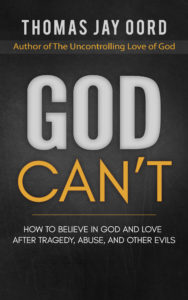
I call the better way I’ve briefly laid out, “Relentless Love Eschatology.” I’ve explained it in various academic presentations. Find an accessible presentation of it in the final chapter of my book God Can’t: How to Believe in God and Love after Tragedy, Abuse, and Other Evils (SacraSage 2019).
Relentless Love Eschatology says God steadfastly loves now and after we die. God’s love always empowers and calls us to respond in love. God literally loves everyone and everything forever!
Those who cooperate with God enjoy the abundant life that comes from loving God, others, and self. Those who don’t cooperate experience the natural negative consequences of saying no to love.
Our mode of existence in the afterlife differs somewhat from our existence now. The Bible and theologians offer diverse speculations about the nature of this existence (spiritual bodies? souls? disembodied minds? other?). But they agree our future state will not endure the evils, death, and destruction that affect our present bodies.
So…
Will Anyone Be “Finally Impenitent?”
Relentless Love Eschatology says God never forces anyone to salvation. So theoretically at least, some may never repent. And God won’t force them.
This isn’t classic universalism.
Because God never gives up on anyone, however, it’s also possible everyone will eventually repent. Resisting may be possible, but God’s relentless love may finally persuade all to embrace love. We have hope but no guarantee all will be saved.
Is it likely everyone and every choosing creature — the whole world — will eventually cooperate with God? Or should we assume at least some choosers will be finally impenitent?

John Wesley seemed to think the whole world would repent. I close with his words:
“In the same manner as God has converted so many to himself, without destroying their liberty, he can undoubtedly convert whole natures or the whole world. And it is as easy for him to convert a whole world as one individual soul.” (General Spread of the Gospel)
Amen!