
For several decades, I’ve opted to identify a few basic ideas that comprise the umbrella I call “open and relational theology.” Under that umbrella stand many people, movements, and claims. I’ve described this theology in my new book, Open and Relational Theology: An Introduction to Life-Changing Ideas. It will be available this summer.
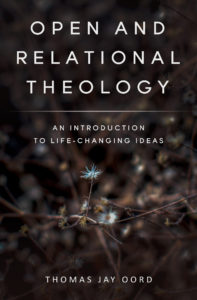
Open and relational thinkers believe God gives and receives in relation to creation. That’s relational. Both God and creatures experientially move into an open future. That’s open. They also stress issues related to God’s love and presence in the universe. And so on.
I coined the label “Open and Relational” to bring together isolated groups and individuals to form a group at the American Academy of Religion, joined by my co-chair Lynne Lorenzen. The group remains a strong voice at AAR, and as of this writing is co-chaired by Krista Hughes and Andrew Schwartz.
Open and relational thinkers don’t agree on everything. And my emphasis on a big umbrella doesn’t mean those differences are inconsequential. Difference matters. There’s always a place for exploring and noting them. Exploring those differences is part of the fun of living in relationship with God and others… at least when it’s done respectfully!
Process, Open, or Relational?
Many people ask me to differentiate between process, open, and relational theologies. They want to know, for instance, what makes process theology different from open theology. Some ask about the differences between open theology and relational thought. And some wonder if all relational theologies are process theologies (they aren’t).
These are good questions. Answering each well requires identifying the essential ideas of each theology. A close look at those who self-identify as process, openness, or relational reveals diverse lists of essentials. What is essential to one person’s theological view is not to another. And there’s no official list.

It’s easier if we look at the ideas proposed by specific people. I can point to differences and similarities between Catherine Keller and Gregory Boyd, for instance, but even that evaluating can get complicated.
I sometimes respond to these questions by saying, “the typical, self-identifying open theist believes x.” Or “the typical, self-identifying process theist believes y.” These generalizations help, but they don’t account for many who don’t fit what’s “typical.” Some self-identify with one label, say “process theology,” but hold views typical of another label, say “open theology.” Confusion reigns.
Instead of building a massive chart, constructing a thematic tree with roots and branches, or making a list of “10 Essential Ideas of ___ Theology,” I point to two general views as common for open and relational thinkers: God is relational, and the future is open. I then celebrate, ponder, and argue over the diverse ways to understand these ideas and others.
I admit this “big tent” approach is sometimes messy. But I find it more effective than either a strict list of beliefs or a “whatever works for you” approach. The first excludes all but a select few who affirm every jot and tittle. The second promotes confusion and renders labels meaningless. The big tent approach is broadly inclusive without dismissing distinctions.
Religions, Denominations, and Other Labels
Open and relational thinkers come from or identify with various religions and movements. I’ve done no official survey, but I’m confident more open and relational thinkers identify with Christianity than any other religion. The Christian denominations and movements with which open and relational thinkers identify are diverse.
You can find open and relational Adventists, African Methodist Episcopal, Anglicans, Baptists, Church of Christ, Church of England, Church of God, Church of the Nazarene, Congregationalists, Covenant, Disciples of Christ, Eastern Orthodox, Episcopal, Free Methodists, Latter-Day Saints, Lutherans, Mennonites, Methodists, Pentecostals, Presbyterians, Quakers, Roman Catholics, Salvation Army, Unitarians, United/Uniting Churches, United Church of Christ, and more.

Open and relational thinkers sometimes identify primarily with a particular way of thinking rather than with a specific denomination or religion. There are open and relational Anabaptists, analytic theologians, Arminians, Calvinists, charismatics, continentalists, evangelicals, exvangelicals, feminists, intersectionalists, liberationists, postcolonialists, progressives, theopoetics, Wesleyan, and womanists.
Some open and relational thinkers are members of other religious and non-religious traditions. These include African religions, Bahai, Buddhism, Indigenous religions, Interfaith, Islam, Judaism, Nones, Paganism, Spiritual but not Religious, and more.
I see this diversity as a strength. The ideas of open and relational theology transcend any one group or religion. The movement is broad enough and ideas appealing enough to appreciate the diversity, while pointing to a few ideas that unite.
Did I Miss Something?
By the way, I’m always interested in adding to the above list of religions, Christian denominations, or other labels open and relational thinkers embrace. Send me a note if I’ve missed a label on my list.