Morals for Animals
Given the many celebrations of Charles Darwin’s life and work that are occurring this year, I decided to reread his most famous books. I especially like The Descent of Man. What Darwin says about morals in that book is truly provocative.
Darwin argues that humans and nonhumans share much in common. He assigns a large portion of The Descent of Man to surveying evidence that supports the view that continuity exists between humans and nonhumans. Much of this evidence comes from body shapes and features. Some evidence for continuity comes from mental and emotional similarities. “The close similarity between man and the lower animals,” Darwin concludes, “cannot be disputed.”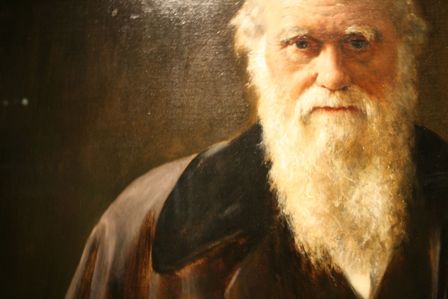
In the last decade, the evidence for similarities between humans and nonhumans has substantially increased through the study of genetics. The human genome has been found to be virtually identical to the chimpanzee genome. Were we to paste the genetic sequence of a mouse next to a human genome, the nonscientists would likely not see a difference. The continuities between creatures are astounding.
What I especially enjoy considering in The Descent of Man, however, are Darwin’s ruminations on morals. He speculates that the fundamental basis for morals is the social nature of existence. “The so-called moral sense is aboriginally derived from the social instincts,” he conjectures. “Social instincts lead an animal to take pleasure in the society of its fellows, to feel a certain amount of sympathy with them, and to perform various services to them.”
The impulse to help others may become habitual, and the community plays a key role in forming these habits. In fact, says Darwin, the social instincts, along with the aid of the intellect and the effects of habit, lead naturally to the golden rule: Do to others as you would have them do to you. In The Descent of Man, we find a biological basis for the emergence of love.
Morality is not limited to humans, says Darwin. Moral continuity exists between humans and nonhumans; all social animals have some sense of right and wrong. For instance, Darwin notes that animals perform services for one another. Animals also sometimes warn one another of danger. Animals serve one another through parental and familial care. And creatures sometimes sympathize with each other’s distress.
Recent research by Frans DeWaal on nonhuman primates and Marc Bekoff on canines confirms Darwin’s view that nonhuman animals possess a degree of moral capacity. De Waal says that “a chimpanzee stroking or patting a victim of attack or sharing her food with a hungry companion shows attitudes that are hard to distinguish from those of a person picking up a crying child, or doing volunteer work at a soup kitchen. To classify a chimpanzee’s behavior as based on instinct and the person’s behavior as proof of moral decency is misleading, and probably incorrect.” Bekoff argues that “we do not have to ascribe to animals far-fetched cognitive or emotional capacities to reach the conclusion that they can make moral decisions in certain circumstances.”
Darwin even speculates that at least some nonhuman animals have something like a conscience. He says that “an inward monitor would tell the animal that it would have been better to have followed the one impulse rather than the other.” The differences between “man and the higher animals, great as it is, is certainly one of degree and not of kind.” After all, says Darwin, “the senses and intuitions, the various emotions and faculties, such as love, memory, attention, curiosity, imitation, reason, etc, of which man boasts, may be found in an incipient, or even sometimes in an well-developed condition, in the lower animals.”
I plan to post more on the subject of animal morals and their similarities and difference with human morals. But I’m curious what you think about the claim that nonhumans exhibit moral similarities with humans.
Is this good news or bad?

Newsletter
For a 200-page book of Thomas Jay Oord's best-selling writings and to receive his newsletter, add your email address...
Comments
It just tells me that creation is woven toghether. So many times we disect and put subjects in a box and study it. But in my oppinion it was never the case. Everything is connected. Just like the emotional effects the physical. Both can be studied separatly but they still belong and share and influence the same body. It’s a relational thing…
Interesting and controversial topic, but an important question to ask. Too often those of us who wish to emphasize the differences between man and beast dismiss these questions without truly contemplating them. Perhaps the answer rests in the metaphysics of soul and spirit. Undeniably, there is a similar foundation in creation that results from the nature of God, but where do we draw the line between accountable man and the entrusted creation?
You might enjoy watching the 3 part series on Nova called “Becoming Human.” A friend and I watched it together and it generates some interesting conversation. It is available on the Nova website in the archives, I think. Try this link…. http://www.pbs.org/wgbh/nova/beta/evolution/becoming-human-part-1.html Let me know if it works.
John Brasch
could it be that some of these ‘higher things’ morals, kindness, a sense of what is right and good are aspects of the creators nature and as the creator interacts with all of creation it is all influenced by him.
Maybe an aspect of what we in my tradition refer to a preventing grace maybe something a bit more developed.
many who have owned dogs or even other pets have seen them act in the pest interest of others even knowingly putting them self in harms way for those who are ‘close to them’ alla “Old Yeller”.
Thanks, Courtney, John, and Steve. These are great insights and questions.
And, John, I got the link to work. The series looks interesting!
There is little doubt that “morality” exists in animals. Selection pressures on animals led to things we consider moral behaviors—such as a sense of justice being in tensionwith a sense of reconciliation. Frans DuWaal (Yerkes Primate Center Director) has shown countless time that non-human primates have reconciliation rituals employed after one of the primates transgresses. Similarly, they seek vengeance (and justice) within the troupe. But a balance exists, necessitating both justice and reconciliation. If there were no justice, no punishment for a transgression, then greedy primates would monopolize the resources of the troupe and many members would not survive. There is selection advantage in troupes that have justice. But, if punishment damages the offender or casts the offender out of the troupe, then the offender is subject to predation and the troupe is decreased in strength by one. Thus, selection advantage goes to animals that can also reconcile.
However, it is somewhat misleading to call these moral virtues in the same way we think of humans making reasoned moral decisions. The difference is stark.
On the other hand, the social intuitionist approach to morals put forth by Jonathan Haidt suggests that we make many moral judgments by emotional, intuitive reaction. In cognitive Psychology we have system 1 cognition (i.e., non-verbal intuitional thinking, or “thin-slicing” as Malcolm Gladwell calls it) and system 2 cognition (i.e., rational analysis). Both are legitimate human cognition. System 1 cognition can be subjected to system 2 analytic cognition, modifying it.
Animals appear to have something like pre-system 1 moral cognition. It probably is not like human system-1 cognition, but is a preliminnarly version of it. But they do not have system 2 cognition.
So, yes, there are similiarities in non-human animal and human moral cognition. But the differences are quite profound as well. Let’s not make too much of the simillarities without keeping in mind the differences.
I think that this shows how closely God has created us. I think that we dont’t think of them having morals because we do not fully act on the same level together. But if we think about it they know what is right and what is wrong. If a dog does his/her business in the house they know that it was not the right thing to do.
Thanks, Ev and Jon. With regard to the differences between humans and nonhumans, I struggle to see how the differences are finally a difference in basic kind. Surely the differences in degree are HUGE.
I’m still working on this issue…
It seems to me that any “moral agent” can only be held accountable to the degree that it is able to reason the best moral choice. In other words, to those who are given much, much is required.
I agree, Jamie. And that’s why I think that although nonhuman animals may make moral decisions, their culpability is constrained by the degree they can reason about their choices. I doubt worms do much reasoning. But I’m confident that dogs, dolphins, and chimps can reason.
Animals uniquely mediate to me the mystery of God’s love and creativity. They are gifts of God, part of our common life on this planet. We share the same stuff of creation they have, the “dust” as Genesis puts it. Because they come from God and are beloved to God, and because they are vulnerable to our exploitation, I believe we have a moral obligation to honor and care for animal life, and when we harvest animals for food, to do so in as humane and responsible a way as possible. We have much to learn from Native American traditions in regard to how we relate to animals.
Just as scripture can be used for selfish means, Darwin can take information concerning, “The close similarity between man and the lower animals,” and create a theory that pleases his personal agenda. Perspective has everything to do with outcomes.
Whereas I may look at the similarities between humans and non-humans and see a common creator, Darwin may see a common ancestor… Information that we receive is constantly filtered through a sort of cognitive sieve allowing ideas that we agree with to more easily pass through than those that we do not.
I don’t believe that animals have morals. I believe certain animals can have learned behaviors in which they they can kind of learn right from wrong, but even then that is hard to say. I have a dog and I have told my dog a thousand times not to get into the trash, but sometimes when I am not home she still will get into the trash. I read above some one said something about God created us in his image, not animals. I believe that God didn’t make animals to have the mental capabilities to have morals.
How can anyone believe Darwin on matters of morals especially in his writings at age 40 gave up on Christianity. In 1880 he wrote that he no longer believed in the Bible as a divine revelation of God, or in the Son of God. Everone knows Genesis [2:7} That God formed man from the dust of the ground. And in Genesis [1:26] Describes man in God’s spiritual likeness. In the Hebrew, the word formed, “vayyitzer” is written with two “yods” therefore man was created with a “yetzer tob” and a yetzer ra” capable of doing both good and evil. Animals were created with only one “yod” having no moral conflict. That is why an animal can kill without any remorse of conscience. The Bible does not tell us how animals were created or out of what. No I did not come from a monkey.
This and other relevant subjects are covered with scholarly research, brilliant insight and intelligent expression at: twoprophets. For me, it is like the inexhaustible subject of the seasons that can be seen in the changeable light of the sun, or the versatile light of the imagination, as benign or malevolent or indifferent, depending upon a particular poet’s vision at a particular moment. Food for winter is secured. We’re going to call B an exercise instead of an example because that what it is! Accomplish both not likely decide on fashionable boots and shoes let alone boots or shoes simple and easy might be your current feelings is not the You merely while using style,regardless of the wonderful fine quality. gmail
So how do we lay all this out and make it work? Bose 321 DVD Home Theater systems exemplify the ultimate Bose lifestyle. So, when was I born?
http://www.flixya.com/blog/4714703/Video-Conferencing-Firms
http://wiki.monroe.edu/index.php/User:Webconferencing01
https://webconferencing01.jux.com/#255594
http://webconferencing01.moonfruit.com/#/blog/4565717697/Conference-Call-Service-Providers/2650439
http://webconferencing01.mylivepage.com/blog/2068_General/3037_Conference_Call_Hosting_
Write your career objective in a way that demonstrates how it will benefit the company. He cant possibly forget about you!
This post has got me thinking all week, does this mean that animals have spirits? and if they do, can they be held accountable for their actions? I know James L. Dickey wrote in his poem ‘The Heaven of Animals’ that if say, a rabbit lived in the wood, its heaven would be a perfect wood, and a shark’s heaven would be a sea and so forth. I suppose animals could be held accountable to their actions, but only to the amount of degree in which they understand what is morally right and morally wrong, like in Romans where Paul talks about the ancients who didn’t know him being held accountable by the aspects of their conscience, ‘they follow the law written on their hearts.’ So I guess just as John of Damascus said that the existence of God is imbedded into all creatures, so is God’s Law, and that just might be what we classify as ‘moral law,’ or how Titus 2 explains it: ‘the grace of God is in all creatures . . . it is what tells us to say ‘no’ to ungodliness.’ Now, does this mean that when I die I’m going to see my dead puppy? Every time I’ve asked this question, (at least from a protestant perspective) I’ve always been given the answer ‘there will be animals in heaven, but i don’t think they’ll necessarily be your dog or cat . . .’ and now i think, why not? Is God just going to cancel out everything on this planet except for humans? Why don’t our pets get to live in eternity? I guess this stumbles me . . . what do you think about animals going to heaven (or even hell for that matter)? I think by studying animals we find similar traits in them that we do ourselves, but maybe the reason we humans are at the top, or tend the animals like described in Genesis, is because we have the greatest degree of conscience, the one that makes us most like God as compared to all other animals.
In reading this article, it seems that the undertone of it is hinting at the idea that humans and nonhumans are related. But I have to disagree, there is a fundamental difference. C.S. Lewis in his The Four Loves says this “Space and time, in their own fashion, mirror His greatness; all life, His fecundity; all animal life, His activity. Man has a more important likeness than these by being rational.” I know that the article said that animals have seemingly a moral element to their life, but I wouldn’t say that it is anything more than just operating in the manner they were created. Man, on the other hand, was created in the image of God, which is entirely different than just being on a higher level than the other animals.
• I guess it is true that humans and non-humans show similar characteristics. Although, it seems that there is a direct relationship with the complexity of the creature and the genetic makeup of that creature and the human-like characteristics. The chimp like you talked about is very complex and like you said very similar to us, and it makes sense that they would do loving acts and act in humanly ways. I don’t know that they can think abstractly like we can or think to be innovative to see issues or problems in the world like humans do and in that way cannot work to change their circumstances or the world around them. I think God has made us to be very unique in this way and I don’t know if any other being has this ability to think in abstract and outside ourselves kind of way.
This article goes to show how closely God created us, and I think many people, including myself often overlook the possibility of animals even having morals. I believe we overlook or just don’t even think about animals having morals because we don’t act on the same functioning level as they do. I think there are some similarities in nonhuman and human moral cognition. For instance I do believe dogs can reason. When a dog chews a shoe or does something wrong and they see your expression to what they have done, they know that they did something wrong. So, I do believe animals have morals, but I have a hard time believing that animals can think in abstract ways like we humans can. God made us (humans) very unique in the sense of allowing us to think abstractly and I think that is one thing that distinctly sets us apart from nonhumans, like animals.
I’ve never considered morals in animals before. Thinking back to how we began today’s lecture, with Jean Jacques Rousseau in mind, I would say that animals have good in them, and act more on that than humans tend to. When we kill an animal, it is typically for food, and isn’t thought of as evil, or bad to most people. Though the animal never did any harm to anyone it is needed for our survival. The same can be said for when the predator kills its prey. I would agree that we also both have the ability to show compassion towards another. Talk a relationship between a person and their dog. I love my dog, as if he were a human, and I know that my dog knows me, and loves me through his actions. When I drive home, he “talks” to me when he can hear my car coming down the street, and waits for me at the door. When I go out to see him, he puts his paws on my shoulders, then around my waist as if he is hugging me.
The emergence of love from social instincts and habitual behaviors is interesting. Darwin argued that this lead to the golden rule. Emergence is a newer idea to me but I like many aspects of it, and I don’t think they go against Christianity. Emergence, from my understanding, is that organisms evolve a conscious essentially.
I view this not as evidence for Darwin’s theory of evolution, but as further evidence that God is consistent in his creation. His love is evident in the lives of humans, so why shouldn’t it be evident in the lives of creatures as well? When God told Adam to name the animals and have dominion over them, caring for them is implied. I think that animals were made with a capacity to give and receive affection and love, and it is just further evidence of the love that God reveals in his character throughout his creation. This doesn’t mean that we share ancestry with animals, merely that we have the same creator.
I would say that I agree with Marc Bekoff that animals have cognitive and emotional capacities to reach the conclusion that they can make moral decision in certain circumstances. I agree to the “curtain circumstances.” I have trained guide dogs for the blind and you see that in breading they bread for the traits of caring and of calm natures, natures that bring on loving actions. When I’m sick my dog comforts me, when I’m scared she gives me comfort and protects me. She is playful and cuddly. What other ways can she show that she knows she loves me? I don’t feed her, I don’t disobedient her for my mother does. She willingly loves me because I love her. She knows freedom of love because she doesn’t love everyone in my family like she loves me. Just like we don’t love everyone the same. Animals are capable of intentional love.
I think it is very important for people to begin to recognize the mental capacity of animals. This research about the morals of animals is a great start for this progress. I think that too often people think of animals as being purely instinctual and not really being morally responsible for their actions. Although I have a hard time with the idea that animals can be evil, I can see how many more complex non-humans could have moral tendencies. I hope that this kind of research will lead us to begin to respect and treat animals better. If we learn that animals have an idea of right, wrong, compassion, and selfishness, then I think we will begin to give animals more credit mentally than we have been in the past, and hopefully, it will start a movement to treat animals as more than just purely instinctual beings.
I think that the capacity for animals to have morals is not a bad thing. It reveals a certain new depth of character in God’s creation that we weren’t necessarily aware of before. However I do not think that dogs or other animals probably have near the mental capacity to have as highly developed sense of morality as humans do. Also, the notion begs the question that if animals do indeed have a sense of morality, why would God fill the need to implant into animals this character?