
A recent survey indicates that pastors are beginning to change their views on evolution and creation. And I think that’s a good thing!
A 2012 Barna Group report indicates that pastors (clergy) hold a variety of views on how God creates. That’s not surprising. Here’s the chart indicating that diversity:
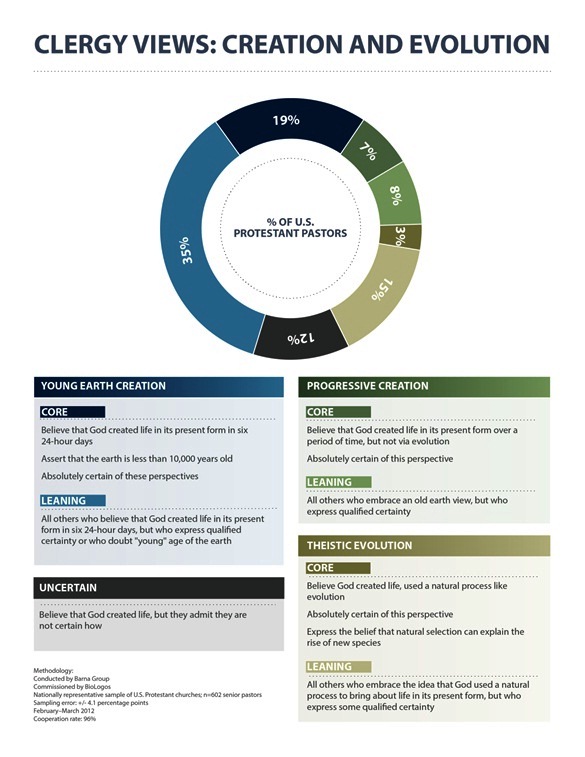
If you dig deeper, however, you’ll find interesting things. For instance, the majority of Southern Baptist clergy affirm young-earth creation. It may surprise you, though, that pastors of large churches are more likely to accept theistic evolution than pastors of midsize or small churches.
Science and Bible
I was happy to see in the Barna report that three out of four pastors think science and faith questions are important. But I found it interesting how pastors who affirm a young earth view thought about Christian witness compared with pastors who affirm theistic evolution. The report shows that 85% of pastors who affirm a young earth position agreed with statement, “Christian disagreement on matters of creation and evolution is compromising our witness to the world.” However, only about 1/3 of pastors who affirm theistic evolution agreed with that statement.
In comparison, about 2/3 of pastors who affirm theistic evolution agreed with the statement, “The church’s posture toward science prevents many non-Christians from accepting Christianity.” And a majority of young earth view pastors disagreed with that statement.
I’m still processing what this difference might mean, but it appears that clergy who affirm a young earth view are “playing defense” against culture. They want to avoid appearing to compromise. Clergy who accept theistic evolution, however, are “playing offense” to reach non-Christians. They worry that issues of science – e.g., evolution – are an obstacle to accepting Christ. This is, of course, a generalization. But it’s a generalization suggested by the statistics, and it rings true to my own experience in various conversations with those on various sides of these issues.
Many who oppose theistic evolution do so, they say, because of the biblical concerns evolution raises. And yet the majority of all clergy whom Barna surveyed agreed with the statement that “some portions of the Bible are symbolic.” Not surprisingly, a higher percentage of pastors who accept theistic evolution say the Bible has symbolic elements. At stake, obviously, is how we decide which parts of the Bible are symbolic and which we should understand in a more literal/historical way.
In another intriguing portion of the Barna survey, clergy were asked whether they would “have a lot to lose in your ministry” should you “admit doubts about human origins.” 58% of young earth clergy said they’d have a lot to lose should they admit doubts. But only 17% of theistic evolution clergy thought they had a lot to lose should they change their minds. For someone those who, like me, affirm theistic evolution, this statistic is a sobering reminder of the high stakes involved for some who may have a change of mind on human origin theories.
Participate in a Survey
These statistics are interesting in many ways. And when I read them, I think about what the survey I’m helping to monitor. In this survey, we ask specific questions about evolution and Christian faith. I encourage everyone to take it, especially those associated with the Church of the Nazarene.
The results of this survey and the results of a survey of Nazarene university educators will be presented publically at the Nazarenes Exploring Evolution conference at Point Loma Nazarene University next Janury 23-25, 2014. Here’s a link with more info.
I’m encouraged by the renewed interest in thinking through the issues of science and faith!