Measuring Love Intentions
To some people, scientific research on love is preposterous. Skepticism runs especially high when a researcher claims to explore loving motives and intentions. But research on the motives of love is possible — and it offers key insights for living well.
In a previous blog, I outlined three major areas of love research (see “Measuring Love”). These three correspond to the three basic aspects of a robust definition of love. The first aspect pertains to intentions and motives.
If love requires intentionality, research on love may explore an agent’s motives and intent. Motives matter.
Of course, scientists cannot place motives under a microscope. In fact, we cannot perceive motives in themselves with sensory perception – sight, sound, touch, etc. This presents a problem for this aspect of research on love, because most scientists presuppose that sensory perception is the only perception possible.
At best, we perceive or become directly aware of our own motives. Even then, we are not likely fully aware of all our motives. Research on love can overcome this problem at least partially, however, by concentrating on a subject’s primary motive for any particular action.
We all presuppose that at least sometimes one motive predominates over other motives when we choose to act in a particular way. And most of the time we can be accurate about discerning our primary motives.
The issues of discerning motives and the role motives play in our decisions are complex. There exists no philosophical or scientific uniformity on the salient issues. My argument only requires the claim that we have motives, that these motives influence our choices, and that we can be cognizant at least to some degree of what our primary motives might be.
I propose at least three general methods for researching primary motives as they pertain to love.
Self Report of Motives
The first method for research on the motives of love involves hearing from those who report their own motives. In particular, self-report based research focuses on what subjects believe to be their primary motives for intentionally acting in a particular way.
 Take the work of psychologists Susan S. Hendrick and Clyde Hendrick, as an example. They used a self-report method to explore the relation of love to religious belief. These scientists asked over 500 participants in two separate studies to report on what kinds of love they express and to report on their religiosity. The self-report study focused on a 42-item love styles scale and addressed six types of love: eros (romantic), ludus (game-playing), storge (compassionate), mania (possessive), pragma (practical), and agape (self-less/religious).
The result of the Hendricks’s research shows that participants who self-report being very religious also self-report expressing more storge, pragma, and agape love forms. These same highly religious people, however, self-report expressing ludus love (game-playing) less than non-religious participants. The Hendricks conclude that “subjects who were more religious endorsed the more ‘dependable’ love styles of storge (compassionate), pragma (practical), and agape (selfless), while they relatively rejected ludus (game-playing).”
Self-reports are advantageous for many reasons. The main one is they emerge from the witness of those who know their primary motives best: the subjects themselves.
The disadvantage to self-reports, however, is that those surveyed may not report their motives honestly. Various incentives may tempt them to characterize their primary motives as loving when they are not.
Scientific research on love based on self-report is important but cannot lead to absolute certainty with regard to the research project goals. But failure to attain certainty does not eliminate it from science. Absolute certainty is not possible for any scientific project, and therefore does not disqualify self-report research methods.
Inferring Motives in Others
The second general way in which love research focuses on motives pertains to inferring a subject’s motives based upon observing its actions. Researchers may rightly infer that some actions are motivated primarily by the actor’s intent to promote well-being. Observation and inference are bedrock activities in scientific research.
Admittedly, inferring another person’s motives entails conjecture. Inference can result in misperception and never attains absolute certainty.
But conjecture and failure to achieve certainty do not disqualify this research method. Other scientific methods based on observation – e.g., scientific explanations for conflicts among Maasai lions or planetary research based on telescope observations – also rely on conjecture and cannot provide explanatory certainty. However, it should prompt those who use this method to be modest and cautious when reporting their research results.
A scientist exploring love can increase the likelihood he or she accurately infers a subject’s motives. A researcher can reduce the likelihood other factors influence a subject to exhibit nonloving primary motives.
For example, Daniel Batson’s research sets up conditions to increase the likelihood he can accurately infer the motives of subjects as loving or not loving. In one experiment, Batson told undergraduates they would form teams of two participants. Each undergraduate would play a role in a stress experience. One student was randomly selected to undergo up to ten electric shocks. The second team member observed the first. Batson told all participants they could withdraw from the experiment at any time. Participants in this test did not know, however, that every undergraduate was “randomly” selected for the observer role.
As assistants escorted each to an observation room, the undergraduate learned he or she would watch on closed-circuit television as a young woman named Elaine – the person they presumed was his or her randomly selected partner – received the series of electric shocks. The scene each student watched, however, had been pre-recorded so that all participants watched the same experience.
By the end of the second “live” shock treatment, Elaine’s reactions were so strong to the electrocution that the assistant administering the treatment “interrupted” the procedure. The assistant asked Elaine if she was feeling okay. A conversation ensued in which Elaine confessed that as a child, a horse threw her onto an electric fence. After the fence incident, a doctor said that in the future, she might react strongly to even mild shocks.
Hearing Elaine’s (made up) story, the assistant wondered aloud if the undergraduate participant watching in the adjacent room might take her place. With a mixture of reluctance and relief, Elaine consented to the assistant checking on this possibility.
After a brief moment, the assistant entered the room in which the student was watching the shock treatments on closed-circuit television. The assistant asked if he or she would be willing to take Elaine’s place. The assistant also gave the person the option to remain an observer.
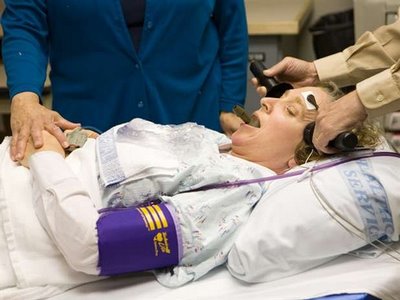 “If you decide to help Elaine by taking her place,” the assistant concluded, “she’ll come in here and observe you. You will go in and perform the recall trials while receiving the shocks. Once you have completed the trials, you’ll be free to go. What would you like to do?”
Batson found that most observers who judged themselves dissimilar to Elaine (based upon previously completed questionnaires) opted out of taking the shocks in her place. However, those who judged themselves similar to Elaine – based on similarities evident in the questionnaires – were likely to take her place, even when they could easily escape the situation.
Whereas only 18% of dissimilar observers helped Elaine when given an easy escape, 91% of highly similar observers helped Elaine when given an easy escape. These results give reason to believe that the primary motive of some people in some situations is genuinely altruistic. They are willing to promote overall well-being by responding intentionally to relieve Elaine’s stress.
Batson’s experiments are powerful, because he sets up controlled circumstances and introduces or eliminates various factors. This helps him increase the likelihood that he can infer correctly a subject’s primary motives.
Batson is quick to say, however, that such studies do not prove irrefutably that the participants expressed love. After all, the possibility always exists that students such as those who took Elaine’s place in the experiment acted with selfishness as their primary motive. It may be that some observers took Elaine’s place, for instance, because they knew they would feel enormous guilt if they did not. Their primary motive was the selfish desire to avoid guilt.
In sum, scientific studies on motives to promote well-being are important. They cannot prove irrefutably that a subject acts lovingly, however. They play an important part in love research generally, because they examine the intentions of those whom may have acted lovingly.
Intentionally Acting on Convictions
A final subdomain of research on intentions and motives explores how personal beliefs, convictions, and principles – when acted upon – influence a person’s decision to love. This research also requires inferences based on observation of actions. But it relies upon observations of others over a long period of time rather than a controlled experiment like the one Batson constructed.
In their book, Some Do Care: Contemporary Lives of Moral Commitments, developmental psychologists Anne Colby and William Damon look at a twenty-three people who are moral examples of love. Colby and Damon use both self-reports and their own inferences based on observation for their research.
The first moral exemplar Colby and Damon present in their book is Suzie Valadez, known as “Queen of the Dump.” Valadez has spent her life handing out food to the poorest of the poor in the squalid conditions outside Ciudad Juarez, Mexico. Valadez worked for more than 30 years helping others, often sacrificing her own health and safety and that of her family members. Colby and Damon report, “She was consumed by the work, fully and completely engaged. For Suzie, her work is her life… As she sees it, the work with the poor of Juarez is what she is her for, what she most wants to do.”
Colby and Damon c onclude that the moral exemplars they studied acted lovingly for others despite difficult circumstances. But all were motivated by unswerving commitment to principles. These moral exemplars have “a common sense of faith in the human potential to realize its ideals,” they report. Faith in the human potential to attain something better is “what made the center hold throughout all the decades of the exemplars’ uniquely consequential lives.”
Conclusion
While the scientific import of the other two aspects of my love definition must wait for future posts, I want to conclude with a brief theological comment.
The arguments above pertaining to motives are important for engaging love research. But I think they should also prompt Christians to ask about the sources, shaping experiences, and mechanisms of motives.
I believe God is the ultimate source of our motives to love. But I don’t think God is the only actor in love. God inspires and empowers love. But our love involves choosing to respond appropriately to God’s prior (prevenient) loving actions.
In addition, the Church and Christian practices can play a major role in shaping and cultivating love motives. What we do in community and the rituals of our lives make some motives possible that otherwise would not be possible.
While what God does ultimately and primarily matters, what we do as persons and communities also matters. The science of loving intentions helps us demonstrate this.

Newsletter
For a 200-page book of Thomas Jay Oord's best-selling writings and to receive his newsletter, add your email address...
Comments
Thanks for this post… I had questioned you previously how one goes about measuring love and this helped answer that question.
I found your “inferring motives” section interesting and it caused me to question my own actions if I were involved in such a situation. To see someone suffering through electric shocks is not an easy thing to do. Of course, neither is homelessness, financial duress or the dissolution of a marriage. If I call myself a Christian, one who knows the love of Christ, then what do I do when I see these things? Do I find myself acting on them, since I know that I come from similar situations and need help myself? Or do I comfortably sit back and allow my head to do the talking while my body enjoys the comfortable state that it finds itself?
This will cause me to notice my actions in the future as I drive down the street, talk to my neighbors and see people in the local Wal-Mart. Thank goodness for the “science” of love that has opened my eyes to myself.
Jason
Maybe I’m just a cynic (okay I admit God has blessed me with the gift of cynicism)but, how reliable are self-reports? In my experience most people try to make themselves look better or think their actions are more ‘pure’ than they may actually be.
Have there been parallel studies which utilized both the self-reporting and inference methods? It would be interesting to see if the self-reports align with what the observers thought. But let’s face it both methods are subjective, not that subjectivity doesn’t occur in other branches of science (maybe it is easier to hide the subjectivity in the so called ‘hard’ sciences).
It seems logical to use science to try to figure out love. It just seems hard to really figure out someone’s motive of love so how can your research really be truthful. I don’t see the problem with trying to see if we could figure out why people love, but it would just be hard to find out fact from fiction because everyone has been brought up in different ways and everyone has a bias starting out on what love is.
I do believe science can and should explore the mystery that is love. There is so much to be learned in such a field about human nature. However, I find it difficult to believe science could ever pinpoint the motive behind acts which seem loving. Especially since so many people do not know what motivates them, how could a third party ever find out.
It has been my observation that individuals increasingly don’t make intention an integral part of why they do what they do. When I asked people why they did what they did, I often got the response, “I don’t know, just because.” In the end, their response didn’t really surprise me. I would say that their response reflected the general direction that culture is headed, which is more pagan. That is why I was struck by what you said, “A final subdomain… explores how personal beliefs, convictions, and principles – when acted upon – influence a person’s decision to love.” This idea of conviction an intention influencing a person’s decision to love is huge. To me it begs the questions, where or how do we get this conviction and intentionality, and how do we get it back into culture?
In your conclusion, you said that, “you believed that God is the ultimate source of our motives to love, but he’s not the only actor in love.” I really like how you worded this and I think it’s true. God does inspire and power our love, but it is ultimately our decision to choose and respond appropriately to God’s loving influence.
At a young age we often wear our motives and emotions on our sleeves. As a teacher, I sometimes see children develop and learn to manipulate others in a way to gain love and acceptance from those around them. When I see this, I always think to myself is this truly wrong or is it just something they’ve learned in order to feel loved and appreciated? This is a tough topic because I think sometimes we have very good intentions or motives, but they go horrible wrong… What are we supposed to do in those kind of situations?
I never have put a lot of thought into what motives one has to love. I have always just skipped over this portion of the idea. As you talked about in this post, everyone’s motives may be different and not what one would expect such as someone taking the woman’s place in the shocking experiment out of selfishness instead of love. This has caused me to pause and begin to think about what my motives are behind my loving actions. From now on I will be more conscious to what kind of motives are behind such acts. I think this may be an important area to study when looking at love; however, I don’t believe science will be able to completely figure out what motives drive people considering we all think differently.
The study mentioned in this blog is interesting; that it was done in the way of observing another in pain and having the option to take their place. Most, I would assume, wouldn’t help a stranger by taking their place. It is our nature to pressure ourselves before another. If this study was done with loved ones (friends & family) I feel as though there would be a higher account of those how opted to take their place in pain. This isn’t because we are indifferent and uncaring people but because it is harder for us to see those we have created a relationship with be in pain. We want the well-bing of all but we want it more for the ones who we interact, so our motive would be self-preservation first then self-sacrifice but when we have Jesus we become sensitive to die to ones flesh and to follow his loving path.
I agree that Batson’s experiment to determine people’s motives is probably not the best. He only saw the results, not the thoughts and emotions driving those results, therefore people could have been acting to avoid shame. However, I think if he would have eventually explained what he was trying to accomplish to his test subjects, it could have led them to examine their own motives, regardless of whether they had decided to take the shock for Elaine or not, which could have inspired them to strive for a more absolute altruism.
This post was interesting to me particularly because I have been taking a behavioral statistics class. We have been learning about different ways to conduct psychological research, and the issue of being able to measure/operationally define ideas such as motivation has been something that we students have had to figure out. Both self-report and inferring-type data collection on something as subjective as motivation have downfalls: either the subjects aren’t truthful or the researchers make the wrong inferences. I think the last type of study, a longitudinal type, seems to get the best and most truthful data when measuring such things as motivation to love because it requires so much time to do the research. As we talked in class, I don’t think that anyone can be truly altruistic. Even our most loving actions are motivated by ourselves, even if that self-motivation is a small aspect.
I find confusion in the ability to “not be able to put love under a microscope.” If lawyers can use motives to more harshly convict a person of a crime, why can’t it be “put under a microscope?” Granted, as we are speaking of Science, I assume that we are speaking of a literal microscope. Why can’t they be examined? In many sciences verbal notations work just as well as physically being able to see something. If you are to tell a psychologist about your motives you will get a majority of them. You won’t get all because I believe that we almost always have subconscious motives as well that we may not even be aware of for some time, if ever. This can somewhat be solved though by your second idea of inferring another’s motives.
Being science-minded though, I do find it difficult to label love, and even motives. Being a Biology major at one point and time, you tend to have theories based on your senses, and what others have previously done. Love would likely, continue to never be wholly proven as many would like, and continue as just a theory.
I do, however, believe that our motives can play a part in the action being loving.
Tuesday 21
The study mentioned in this blog is interesting; that it was done in the way of observing another in pain and having the option to take their place. Most, I would assume, wouldn’t help a stranger by taking their place. It is our nature to pressure ourselves before another. If this study was done with loved ones (friends & family) I feel as though there would be a higher account of those how opted to take their place in pain. This isn’t because we are indifferent and uncaring people but because it is harder for us to see those we have created a relationship with be in pain. We want the well-bing of all but we want it more for the ones who we interact, so our motive would be self-preservation first then self-sacrifice but when we have Jesus we become sensitive to die to ones flesh and to follow his loving path.
I think measuring love is unnecessary because if love is always good and promotes overall well-being, then why is it important to measure it? Studying love is extremely difficult. If we are trying to measure a person’s motivation and/or intentions toward loving acts, then are we studying love or our we studying motives and intentions? I agree, motives and intentionality matters when acting in loving ways. If loving acts are always good and must be intentional in order to promote overall well-being, then the motivation someone has prior to a loving act is also good natured and has purpose. Therefore, all loving acts are intentional and, as you say, are aware of what we are about to do is loving. My criticism is that if we are to make loving habits, then that habit, according to Aristotle, becomes second nature, which does not necessarily mean that love is always intentional, which is not inherently a bad thing. Aristotle had the idea that in order for someone to be truly virtuous they must know the good, do the good, and ‘love the good for its own sake. To illustrate my point better, if something is natural, say eating when you are hungry, then it done with out too much thought (apart from the paradox of choice). My finding something to eat because I am hungry is motivated by the natural cause. Isn’t it analogically similar to say that, in order to get back to our ‘original righteousness’ (as some say), we ought to habituate loving acts so that they may be second nature and eventually become a fundamental or the ‘essence’ of who we are as a person? Shouldn’t Christians eventually just do loving acts without with a second thought. Unfortunately, most Christians need to be intentional first, in order to become properly ‘trained’. I think we agree on this, but I could be wrong.
It would be hard to measure love intensions. I am skeptical of most things so I think measuring something that cannot be perceived with the senses interesting. Figuring out the intentions behind love is a good idea. I like the idea of being skeptical about the peoples intensions because being to trusting is not good.
• The part about which groups chose to take Elaine’s place was quite interesting. Only 18% that were found dissimilar to Elaine were willing to take her place versus a whole 91% who were found to be similar said they would take her place. I think that is very true in my life. I know I don’t do a good job at relating to those who aren’t similar to me, and I don’t know why that is? I think it hinders how we can love. If we didn’t have our guard up and we weren’t always worried about ourselves or ones like us we might say “yes” to God’s call to go do the loving acts his spirit speaks to us each day vs. saying “no” that we often find ourselves saying.
I think that the way we love is shaped by our own experience. I think that these scientific studies carry valid points when it comes to love varying with relation, and our varying motives. We can not purely love someone because we can not fully experience love, if God is love then we are no where near there. In our relations with people we have reasons as to why we have become connected with this person, the motives vary under circumstance. But I don’t think we can help avoiding selfish motives.
I think the self motives point is extremely valid. I believe people come together under a lot of circumstances but weather or not we choose to stay in relation is based on personal evaluation of relevance to ones life. We tend to see how this person will benefit our own well being and if we see that they care then we show the same affection. I also think we choose our relationships that way as well, sociological studies show that people tend to marry within their own social class. However I don’t find it to be selfish that we pick and choose because we can’t carry everyone with us. I do believe in the goodness of people though and feel that even in the smallest of connections we can spread compassion and even demonstrate brief heroic acts of love.
One reason why evaluating motives behind loving acts can be important is so that people, especially Christians, can recognize when “loving acts” they may perform are not motivated by loving intentions. Sometimes our acts of love can be motivated by selfish reasons, such as trying to make ourselves look good to others. We need to recognize these possible weaknesses inside ourselves so that we can be more loving and genuine children of God.