The Spirit’s Love as Free and Necessary
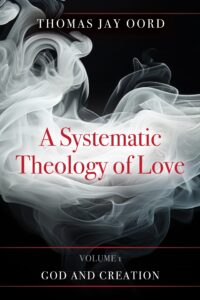
In my newly published book, A Systematic Theology of Love, I put love at the center of my theology. I argue that God is the ultimate lover. And I emphasize the Johannine claim, “God is Love” (1 John 4:8, 16).
But how should we understand, “God is love?”
God IS Love
The biblical text is open to a variety of interpretations. But after exploring this variety, I’ve come to think that “God is love” means that love is an essential attribute of the Spirit’s nature. The Spirit loves, because love is what deity does.[1]
God inevitably loves, no matter the condition of creatures and creation. And God loves everyone and everything, in the sense of acting for their good. God is not free to do otherwise.
To put it another way, there are no circumstances in which deity exists and doesn’t love creatures. And because not even the Spirit can change the divine nature—God “can’t deny himself” (2 Tim. 2:13)—the Spirit of Love should be understood as essentially loving.
Jacob Arminius Says God is Necessarily Not Freely Good
Theologian Jacob Arminius helps us understand how God loves by nature and, therefore, necessarily. Arminius argues that God doesn’t freely decide to be good. “It is the summit of blasphemy to say that God is freely good,” he says. “God is good by natural necessity, according to his entire nature and essence.”[2]
God’s essential goodness is at stake in this debate. “If God be freely good, that is, not by nature and natural necessity,” Arminius argues, “[God] can be or can be made not good.” After all, “as what anyone wills freely, [God] has it in his power not to will; and whatever anyone does freely, he can refrain from doing.”[3] Therefore, God is, according to Arminius, necessarily and not freely good.
Applying Arminian Logic to Love
When we apply this way of thinking to God and love, it means the Spirit isn’t freely loving. With Arminius, we should say that God loves by nature. If God were to decide freely whether to love, God could freely decide not to do so. Not even God could keep God from doing evil, because love would not have logical priority nor be the Spirit’s reigning attribute.
If love doesn’t come first among God’s attributes, there’s no reason to think God will always love us. Or has always loved us. To put it negatively, we can’t trust a God whose nature isn’t love. Such a deity could break bad; the divine could do dastardly deeds. Put positively: we can always trust the Spirit whose nature is love and, therefore, loves necessarily. This Spirit always acts for the good of creation.[4]
Is God’s Love Also Free?
When I explored the definition of love in an earlier chapter of A Systematic Theology of Love, I said love involves freedom. I also said various forces, factors, and actors limit a lover’s freedom. So, does saying the Spirit necessarily loves mean my love definition doesn’t apply to God?
No, it does apply. God loves by necessity in one respect but freely in another. By nature, the Spirit must love, because love comes before choice in God. The divine nature limits what the Spirit can do, if “limit” is the right word for this logical entailment based upon a metaphysical reality. To the question whether the Spirit will love, the answer is God loves necessarily.[5]
But God loves freely as an experiential free agent. As the Spirit moves moment by moment into an open future, deity freely chooses which forms and expressions of love to enact. God can’t be certain which will yield the best results, because the future isn’t something actual to be known, and creatures freely contribute to outcomes.[6] To the question of how the Spirit loves in each moment, therefore, the answer would be that the Spirit freely chooses among the best options in relation to creation. In this sense, God loves freely.[7]
Only in God does love necessarily come before free choice. After all, God is love.
Scriptural Diversity on Love
Saying the God who is love also freely chooses how to love fits important aspects of the scriptural witness. According to scripture, God sometimes regrets and repents.[8] To regret is to wish one would have made a different choice. To repent is to make a different choice than previously or change plans about what will be done in the future. Regretting and repenting language assumes God makes free choices among possibilities, and God can’t be certain which will be most fruitful.
To claim, as I have, that God necessarily loves all requires me to deal with biblical passages that portray God as unloving. For instance, the writer of Malachi has God say, “I have loved Jacob, but Esau I have hated. I have laid waste his hill country and left his heritage to jackals of the desert” (1:2-3). Because God is love, in the sense of necessarily loving, I interpret this passage to reflect the writer’s perspective and not the truth about God.[9] This portrait of the divine comes from mistaken humans.
Does God Need to Be Reminded to Love?
Or take the story of God’s reaction to Israel making a golden calf to worship. The writers of the book of Exodus have God say, “I have seen these people, and they are a stiff-necked people. Now leave me alone so that my anger may burn against them and that I may destroy them” (32:9-10). But Moses says to God, “Turn from your fierce anger; relent and don’t bring disaster on your people” (32:12). Moses then reminds God of the promise of ancestors and land. Exodus says, “the Lord relented and did not bring on his people the disaster he had threatened” (32:14).[10]
I don’t think God needs to be reminded to do good, and I don’t think God ever considers destroying or hating people.[11] I conclude these scriptures don’t accurately portray God. To claim God necessarily loves, therefore, requires us to interpret some biblical passages as reflecting the misunderstandings of the writers that penned them. While the overall portrayal of God points to a Spirit of steadfast love, some passages (wrongly) portray God as unloving.
Or take the writer of Hosea as one who offers diverse biblical language about God and love. At times, God is portrayed as one who threatens humiliation upon Gomer/Israel because of her unfaithfulness. But these threats aren’t genuine, because the text also says the compassionate Spirit can’t abandon or destroy the beloved.
How can I give you up, Ephraim?
How can I hand you over, O Israel?
How can I make you like Admah?
How can I treat you like Zeboiim?
My heart recoils within me;
my compassion grows warm and tender.
I will not execute my fierce anger;
I will not again destroy Ephraim,
for I am God and no mortal,
the Holy One in your midst,
and I will not come in wrath (Hosea 11:8-9).
When the writer portrays the Spirit saying, “I am God and no mortal,” we find a fundamental distinction between the One who must love and creatures who can choose not to love. This passage suggests that God’s nature is love.
All of these examples suggest that biblical writers, like us, were learning what love looks like.
Conclusion
To say God loves necessarily in one sense and freely in another overcomes a host of theological problems that arise in most systematic theologies. It allows us to say love is God’s superessential attribute — the divine “heart.” But because God freely chooses how to love, the Spirit is not an automaton.
For more, I encourage you to read the entire chapter from which the excerpt above comes.
[1] Ilia Delio writes powerfully about God’s nature of love in The Emergent Christ (Maryknoll, NY: Orbis, 2012).
[2] See Works of James Arminius, William Bagnall, trans. (London: Derby, Miller, and Orton, 1853), 344, 345.
[3] Ibid., 345. Emphases added.
[4] John Peckham addresses issues like these in The Love of God: A Canonical Model (Downers Grove, IL: InterVarsity, 2015). He argues that God’s love for the world isn’t necessary but also not arbitrary. Given that Peckham predicates God’s love ultimately upon the divine will, I see no way he can overcome the charge of arbitrariness. On this, see Peckham’s chapter, “The Volitional Aspect of Divine Love.”
[5] Some open and relational theologians put God’s free choice logically before God’s nature. Or they affirm divine freedom and dismiss divine essence altogether. For reasons I note in this and future chapters, I disagree. But for examples of open and relational thinkers who prioritize freedom above all else, see Paul Fiddes, The Creative Suffering of God (Oxford: Clarendon, 1992) and Jon Paul Sydnor, The Great Open Dance: A Progressive Christian Theology (Eugene, OR: Pickwick, 2024).
[6] Ryan Patrick McLaughlin explores this in relation to my claims about amipotence. See his arguments and my response in “The Loving God Incapable of Love,” originally published in Amipotence, vol. 1, Chris S. Baker, et. al., eds. (Grasmere, ID: SacraSage, 2025).
[7] The helpfulness of distinguishing between God’s nature and experience seems to have eluded Arminius, influenced as he was by Luis de Molina.
[8] Terrence Fretheim writes often and well about divine repentance in scripture. In addition to Fretheim’s books, see “The Repentance of God: A Key to Evaluating Old Testament God-Talk,” Horizons in Biblical Theology, 10.1 (1988), 47-70.
[9] John Wesley assumed problematic biblical passages could be interpreted to affirm God’s love. “No scripture can mean that God isn’t love, or that his mercy isn’t over all his works.” See “Free Grace,” The Bicentennial Edition of the Works of John Wesley, Vol. 3 (Nashville, TN: Abingdon, 1984), 556. On Wesley’s hermeneutic of love, see Rem B. Edwards, “John Wesley’s Non-Literal Literalism and Hermeneutic of Love” Wesleyan Theological Journal 51:2 (2016):26-40; Edwards, John Wesley’s Values — And Ours (Lexington: Emeth, 2013).
[10] On this story and others like it, see Matthew Korpman, Saying No to God: A Radical Approach to Reading the Bible Faithfully (Glen Oak, CA: Quoir, 2019); J. Richard Middleton, Abraham’s Silence: The Binding of Isaac, The Suffering of Job, and How to Talk Back to God (Grand Rapids, MI: Baker, 2021).
[11] Eric A. Seibert addresses divine violence well. See Disturbing Divine Behavior: Troubling Old Testament Images of God (Minneapolis: Fortress, 2009); The Violence of Scripture: Overcoming the Old Testament’s Troubling Legacy (Minneapolis: Fortress, 2012).

Newsletter
For a 200-page book of Thomas Jay Oord's best-selling writings and to receive his newsletter, add your email address...
Comments